
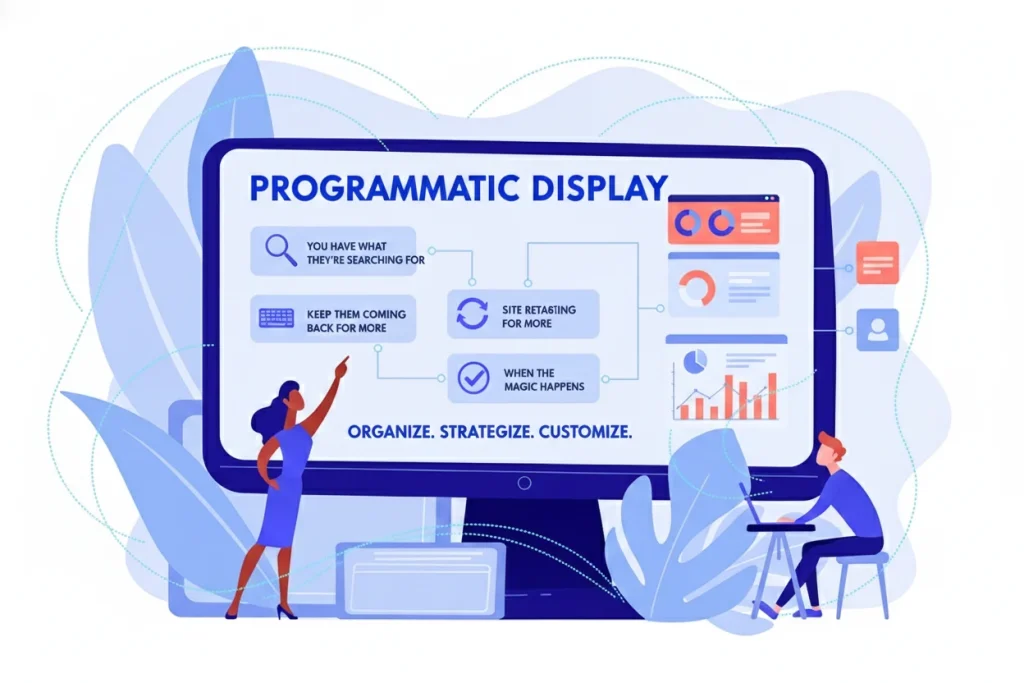
The Mechanics of Programmatic Display– Display Retargeting: Turning Views into Interest and Interest into Profit
An online advertisement for Eli’s Electric Solutions is posted on a website that discusses technology and appliances. A user stumbles upon it. Eleanor, who has been looking to spruce up her home with new technology, is a perfect match for the company. She is a newly married thirty-year-old woman who has recently been searching for new lighting for her home online as well as other technology for home improvement. She and her husband have a stable household income and are located in southern New Hampshire. Upon viewing the advertisement, she thinks to herself, maybe I’ll check that out. I’ll keep it in mind.
This is where display retargeting plays a large role. Retargeting is additional targeting of a potential consumer that has already seen an advertisement for the business at least once before. It aids in keeping the potential consumer engaged with the company and aims to encourage them to become an active customer. When a potential consumer views a second advertisement for a business, it may give them more reasons to explore it further or even just serve as a gentle reminder to visit their website.
You Have What They’re Searching For
Search retargeting allows a brand to pursue potential consumers based on their previous keyword searches online. It has similarities to behavioral targeting, but what sets it apart is that search retargeting seeks individuals that have already seen an advertisement for the brand once before and whose keyword searches have remained consistent, indicating that they are still interested in what the company has to offer. Essentially, it aligns a company’s search engine marketing (SEM) with display advertising. Search retargeting is a double threat!
It has now been a few days since Eleanor viewed the advertisement for Eli’s Electric Solutions. In this time, she has continued looking for new technology to make her home more interesting and modernized. This has included searching for appliances, technology, and electrical devices online. A new advertisement for Eli’s Electric Solutions catches her attention and she lingers on it, reading into the brand a bit more.
Keep Them Coming Back for More
It is a frequent occurrence that potential consumers do not purchase a product the first time they visit a company’s website. This is especially true the more expensive the goods and services being offered by that company are. Site retargeting pursues individuals that have previously visited a company’s website. It is a strategy directed toward those who have already decided that they want to purchase the goods or services a brand offers but are deciding which company to buy from.
To utilize site retargeting, a pixel is included in the brand’s website which sets a cookie in the browser of whomever views it. Site retargeting takes place over four simple steps. First, the potential consumer views an advertisement for the business. Upon seeing the advertisement, they engage with the company’s website. They then view other websites related to the goods or services they are looking for and see a retargeted advertisement from the company. Finally, they select the advertisement and return to the website ready to make a purchase.
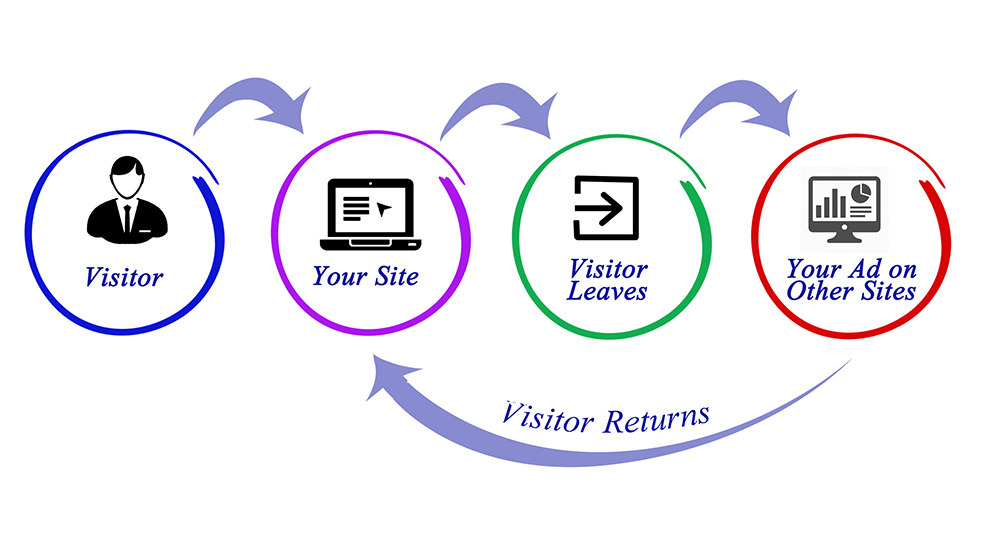
Eleanor explored Eli’s Electric Solutions’ website after seeing their second advertisement. She is interested and definitely wants to invest in electrical services to install the new appliances that she ordered. After leaving the website, she begins to look at other websites regarding electrical services when she sees another retargeted advertisement from Eli’s Electric Solutions. Eleanor selects the advertisement, ready to move to the next stage.
When the Magic Happens
The conversion stage is arguably the most exciting process of programmatic display. Conversions occur when a viewer of a company’s website meets a desired goal. A conversion means a positive change has occurred. Viewers of your website may convert to leads or even customers if they make a purchase.
A post click conversion occurs when a potential consumer selects an advertisement and then clicks on a link or fills out a form within it. A post impression conversion takes place when a potential consumer viewed an advertisement but did not click on any links or fill out any forms. They instead visited the website manually and selected a link or filled out a form. Conversions can be tracked through pixels embedded into the company’s website.

Ready to make a purchase, Eleanor returns to the Eli’s Electric Solutions website. She fills out a form on the site to receive a quote from the company, converting her from a potential consumer to a lead. This conversion is tracked through a pixel included in the website.
Organize. Strategize. Customize.
As a business owner, programmatic display is an important tool that you can utilize. However, it is also important to recognize that you have the freedom to use it however you see fit for your company. Frequency targeting and day parting are a couple of methods that allow for customization. Frequency targeting enables you to set limits on or increase the number of times an advertisement is viewed. Day parting gives you control over when individuals can see an advertisement. It could be set to specific days of the week or even certain times of the day.
Programmatic display is all about defining your target audience and attracting them to your brand. The techniques and strategies mentioned in this series will be hugely helpful in accomplishing this. Utilizing the processes of programmatic display will help you to find the right people and help the right people to find you.
Ready to Take Your Brand Beyond Ordinary?
Your marketing shouldn’t just exist. It should perform. If you’re done settling for “good enough,” let’s build something impossible to ignore. Brandit helps you connect every digital, physical, and promotional touchpoint into one unstoppable brand experience.
Real Results,
Real Reactions
What Our Clients Say

"I sent out three bids for my marketing needs for this year and Brandit was the most responsive and provided great ideas. One company I reached out hadn't even gotten back to me while the other wasn't even close to being comparable to Brandit's creativity, pricing and service."
"I have used Brandit for several projects and they always come through with fantastic pricing and customer service. I highly recommend them."
Southern New Hampshire University

"Thanks to Brandit's generous contribution to the Big Ideas for Building Independence Capital Campaign, Easterseals NH is now better able to serve people with disabilities or special needs. With your support, we raised nearly $2.6 million for renovations to our headquarters."
"It has been an incredible journey! We couldn't have done it without you, and wish to take this opportunity to thank you and your team at Brandit Marketing Solutions for all that you have done and your generous donation."
Easterseals, NH

"Bringing Brandit Marketing Solutions into the CMC-fold is the best thing and most appreciative thing I've done since being at the Hospital."
Catholic Medical Center
"Exceptional does not even begin to cover the work that these people do. I have worked closely with other marketing firms and Brandit tops them every time. From innovative ideas to customer service that rivals the best of the best. I just couldn't speak more highly of them."
Southern New Hampshire University

"The Granite Group, headquartered in Concord, NH, distributes plumbing, heating, cooling, water and propane supplies to contractors and fuel dealers across New England through over 45 wholesale branches and their Online Store. The company also operates 15 retail showrooms under The Ultimate Bath Store name.
Brandit is pleased to say that we have been working with the Granite Group for over ten years which happens to be almost as long as this company has been in existence. In 2020, TGG was named one of New Hampshire's best places to work."
The Granite Group
10+ Year Partnership

"Over my long career, I have been in a position where I have worked closely with numerous vendors/suppliers. I can honestly say that I have never engaged with a company that is as amazing and responsive as Brandit."
"A sincere thanks to the team for the hustle on getting our shirts and tradeshow materials done for our group! You really relieved our pressure and I know it wasn't an easy task. Your effort and turnaround time was and is appreciated. Believe me when I say that I do not take for granted the relationship we have built over the years. Your service is top notch."
C&S Wholesale Grocers

"For almost a decade, the team at Brandit delivered successful and effective marketing solutions, spearheaded the merchandising of the FIRST brand by creating one-of-a-kind products, built, hosted, and managed their very first ecommerce store supporting all programs, staff, partners, sponsors, teams, and customers globally.
In addition, Brandit set up and managed multiple on-site retail stores at their premier Championship events where we serviced over 65,000 attendees. Today we provide web services as well as branded merchandise for regional partners".
FIRST Robotics

"The Brandit Marketing Solutions Ltd Team is wonderful to work with and we appreciate what they do to make us look good! They have expanded their services in recent years to meet whatever marketing needs you may have…from apparel and giveaway items to video and web services to graphic design and printing services, even graphic enhancements for your interior/exterior office space."
"I have worked with this team since the founding of their company and look forward to many more years of working together!"
Boys & Girls Club of Manchester

"The Brandit team is a talented group of creative professionals that I've worked with for years. Top notch!"
Art Murphy
Our Insights
.
Brand Consistency: Make Your Site & Sign Match
Your website looks sharp. Your storefront sign looks fine. Your business cards came back a slightly different shade of blue than you remembered. Each one on its own seems like a small thing. Together, they cost you customers and money. Brand consistency is whether everything a customer sees from you looks and sounds like it…

Sustainable Promotional Products: A Buyer’s Reality Check
That recycled tote you ordered for the trade show has a problem. The product page called it eco-friendly, you felt good about the choice, and you moved on. Here is the uncomfortable part: when auditors actually test merchandise carrying self-declared green labels, close to half cannot back up the claim. The word on the page…
What Is AI Search Readiness and How Can Local Businesses Improve Visibility?
Your next lead may begin with an AI agent researching your company before a person ever visits your website or contacts your team. Google is expanding the ways its AI-powered Search tools can help people find and compare local providers. A customer can describe what they need, ask Google to research nearby businesses, and use…
Premium vs. Volume: Rethinking Your Promotional Products Budget
You order 500 pens for the trade show. They cost a little over a dollar each, they have your logo, and they feel like a responsible use of the budget. Three weeks later, most of them are in a junk drawer, a parking lot, or a trash can. A few never made it out of…

Holiday SEO Timeline: Why December Rankings Start in Summer
The businesses that dominate search results this December made their move back in July. Not out of habit. They moved early because search rewards steady, consistent work in a way that no last-minute push can replicate. Holiday SEO is not a campaign you switch on when the decorations come out. It is an advantage you…

Corporate Holiday Gifting Timeline: Why Q4 Planning Starts in July
Here is the part nobody tells you about corporate gifting: the best time to lock in your holiday program is right now, in July. Not October. Not “right after Halloween.” July. That sounds early enough to be a joke. It is not. The companies that run corporate gifting well, sending memorable and on-time gifts to…

Website Performance Audit: Why Q3 Beats Q4 Every Time
Your website traffic is about to drop. Vacations start, inboxes go quiet, and the steady hum of summer browsing replaces the urgency of buying season. Most businesses read that slowdown as a reason to coast. That is the expensive mistake. The quiet stretch from July through September is the best window all year to run…

Summer Foot Traffic: Win It With a Mobile-First Website
Picture a family on a sidewalk in Portsmouth on a Saturday in July. It is 86 degrees, the kids are hungry, and someone pulls out a phone and types “lunch near me.” Three places show up on the map. They tap the first one. If that site loads fast and the menu is right there,…

Modern Phishing Scams: What Smart Businesses Need to Know
The old advice for spotting a scam email no longer works. Watch for bad spelling, awkward grammar, and a generic greeting, and you were safe. That rule protected people for years. Modern phishing scams have erased every one of those tells. Attackers now write clean, personalized messages, hide their links inside images, and move the…

Branded Koozies and Sunglasses Aren’t Lazy: High-Yield Summer Promotional Products
Someone on your team just rolled their eyes at the idea of branded sunglasses. Too obvious. Too expected. Let’s do something clever instead, maybe a little desk gadget or a puzzle nobody asked for. That instinct feels smart. It usually costs you the campaign. Here’s the part most people miss: the “clever” item lives on…
Omnichannel Marketing Solutions
Merging creativity and technology for comprehensive brand experiences.

PIXELS
Harnessing digital platforms for impactful brand promotion and audience engagement through strategic touchpoints.

PROMOS
Making the intangible tangible through high-quality promotional items that echo your brand's voice and values.

PLACES
Transforming physical environments into powerful brand narratives that forge connections with everyone who enters your space.