
Local vs Traditional SEO: Which One Does Your Business Need?
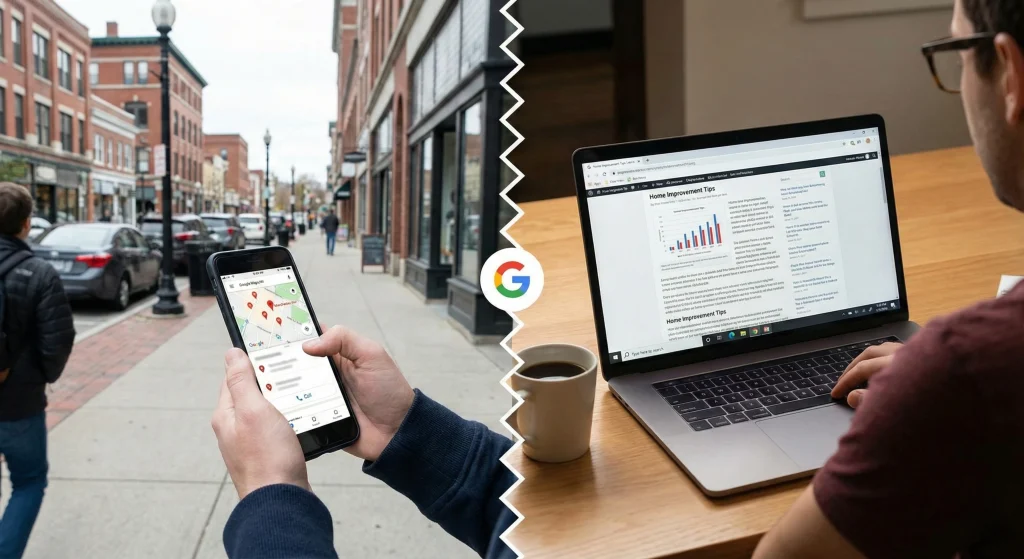
Ever searched “coffee near me” or “roofing contractor in Manchester, NH” and instantly saw Google Maps listings, business reviews, and contact info at the top?
Now compare that to searching “best home decor ideas” where blog articles, Pinterest boards, and ecommerce sites dominate.
This isn’t a coincidence. It’s Google interpreting your search intent and deciding whether to show local results or broader, informational content.
That decision is powered by two distinct SEO strategies: Local SEO and Traditional SEO.
Local SEO helps your business rank when people nearby search for services like “best pizza in Hooksett” or “dentist near Elm Street, Manchester, NH.”
Traditional(Organic) SEO targets broader, non-location-specific terms like “how to fix a leaky roof” or “best CRM for small businesses.”
Why Your Business Needs Both
Successful businesses don’t choose between Local SEO and Traditional SEO. They use both to win locally and scale nationally.
Local SEO ensures you appear in map packs and local listings when nearby customers search for services. Traditional SEO helps you rank for broader topics that drive authority, traffic, and long-term growth.
At Brandit Marketing Solutions, we blend strategy across:
- PIXELS: Local + Traditional SEO that ranks your brand in maps and organic search
- PROMOS: Branded merchandise that keeps your business top-of-mind
- PLACES: In-person activations that create memorable customer experiences
We help businesses across New Hampshire and Massachusetts connect at every local and digital touchpoint, from Google Maps to community events.
What You’ll Learn in This Guide
Not sure when to focus on Local SEO, Traditional SEO, or how to combine both? This guide makes it simple.
You’ll learn:
- The key differences between Local SEO and Traditional SEO
- When to use each strategy and why it matters
- How to combine both to drive faster, smarter growth
This guide applies whether you:
- Run a local café or service business in Manchester, NH
- Operate a landscaping or plumbing company across New England
- Sell products to customers nationwide
Why this matters: According to the SOCi 2024 Local SEO Report:
- 80% of U.S. consumers search for local businesses weekly
- 32% do so daily
If your business doesn’t show up in local search results, you’re missing high-intent customers actively looking for your services.
At Brandit Marketing Solutions, a Local Marketing & Branding Agency based in Hooksett, NH, we create integrated strategies that combine:
- Local SEO for map visibility and proximity-based searches
- Traditional SEO for authority-building and content-driven growth
We help New England businesses increase foot traffic, boost online visibility, and convert searchers into real customers at the exact moment they’re ready to act.
What Is Traditional SEO & Who Needs It Most?
Traditional SEO helps your website rank in Google for non-local, topic-based searches across your state, the U.S., or worldwide.
Unlike Local SEO, which targets nearby searches like “plumber in Manchester, NH,” Traditional SEO focuses on broad, informational keywords such as:
- “best skincare routine for oily skin”
- “email marketing tools for small businesses”
- “how to build a personal brand”
These keywords aren’t tied to a location, so the competition is higher, but so is the potential reach.
What Traditional SEO Includes:
Keyword Research: Discover what your audience is searching for
On-Page SEO: Optimize content with helpful copy, headers, and meta tags
Technical SEO: Improve site speed, mobile responsiveness, and user experience
Backlink Building: Earn links from reputable sites to boost authority
Content Marketing: Create blogs, videos, and guides that answer real user questions
Who Needs Traditional SEO?
Focus on Traditional SEO if you:
- Run an ecommerce store or sell digital products
- Offer a SaaS or subscription-based service
- Publish educational or industry-specific content
- Want to reach a national or global audience
Real-World Example:
A skincare brand in New Hampshire that ships nationwide should use Traditional SEO to rank for terms like “best organic face wash” because potential customers aren’t limited by location.
However, Traditional SEO alone isn’t enough if your business depends on local foot traffic or regional leads.
Next, we’ll explore why Local SEO is essential, especially for service businesses in Manchester, NH and surrounding areas.
What Is Local SEO & Why It Matters for Manchester, NH Businesses
When someone in Manchester, NH pulls out their phone and searches “plumber near me” or “best coffee near Elm Street,” Local SEO determines whether your business shows up with a map, directions, reviews, and a tap-to-call button.
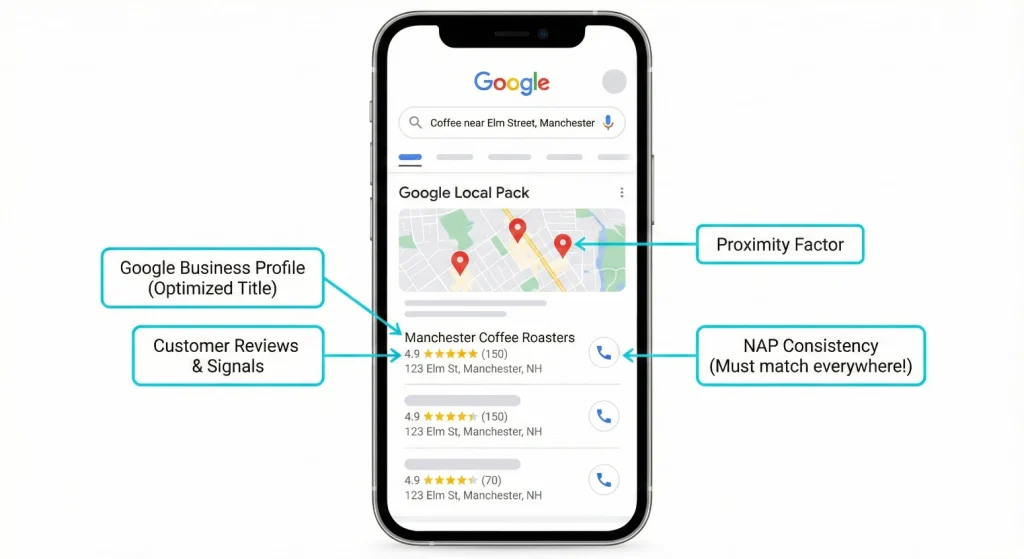
Local SEO ensures your business appears exactly when and where local customers are searching on Google Maps, in the Local Pack (top 3 map listings), and via voice search.
What Local SEO Involves
Local SEO connects your physical location to digital search using these key elements:
Google Business Profile (GBP)
Your official listing on Google Maps; critical for visibility
NAP Consistency
Name, Address, and Phone Number must match across all platforms (website, Yelp, directories)
Customer Reviews
Google values reviews and how your business responds to them
Local Keywords
Include phrases like “electrician in Manchester” or “HVAC near Hanover Street”
Location Pages
Create individual pages for towns you serve (e.g., Nashua, Concord, Salem)
Local Citations
Add listings on trusted directories like Yelp, Yellow Pages, and Bing Places
Mobile & Voice Optimization
Most “near me” searches happen on mobile and through voice assistants, so your site must be fast and responsive
Who Needs Local SEO the Most?
Local SEO is essential for businesses that depend on foot traffic or nearby leads:
Brick-and-mortar businesses: Restaurants, gyms, salons, retail stores
Service providers: Plumbers, roofers, electricians, HVAC techs
Local professionals: Dentists, doctors, real estate agents, therapists
Franchises and multi-location brands: Serving multiple cities or neighborhoods
Real-World Example:
A roofing contractor in Manchester, NH should appear in results for searches like “roof repair Manchester NH” or “leaky roof near me.” These local searches often happen on mobile, and the first result seen is usually on Google Maps, not a blog.
Local SEO bridges the gap between your storefront and digital presence. It helps customers in Manchester, Hooksett, Nashua, and surrounding areas find your business in real time when they’re most likely to take action.
What Are the Key Differences Between Local & Traditional SEO?
Local SEO and Traditional SEO both help your business get discovered, but they serve different goals, platforms, and audiences.
Local SEO helps you show up in Google Maps, mobile searches, and voice queries when someone nearby is ready to buy.
Traditional SEO focuses on ranking your website for non-location-based searches like national blog posts, product guides, or how-to content.
So, Which One Should You Focus On?
Use Local SEO if you run a local service, storefront, or cater to nearby customers in Manchester, Hooksett, or Nashua.
Use Traditional SEO if you want to reach a national audience, sell digital products, or publish educational content.
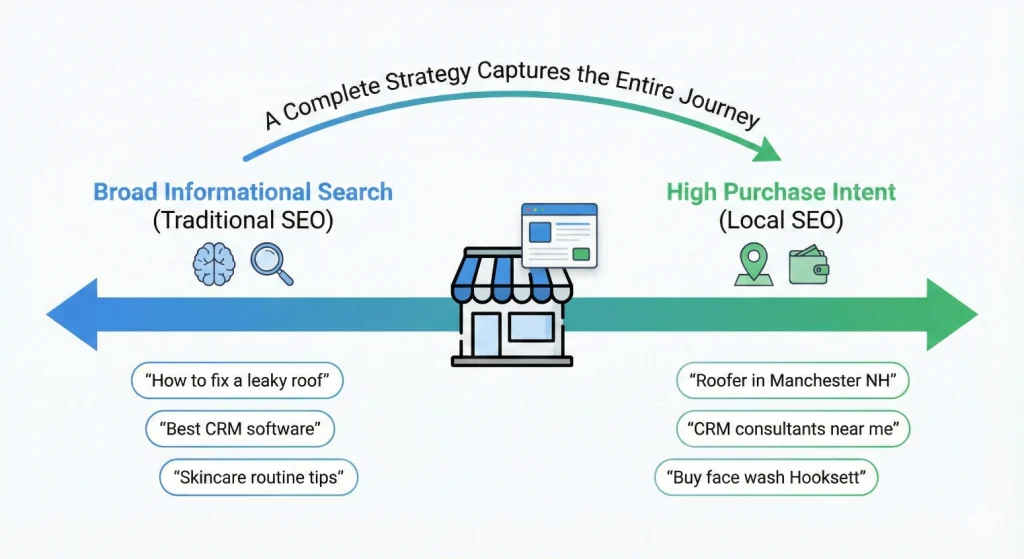
Most New England businesses need both. Rank for local intent searches like “best flooring company in Manchester,” and also publish broader blog content like “how to choose the right hardwood floor.”
This combined SEO strategy helps you capture immediate leads and build long-term visibility, turning local searches into real customers and expanding your digital reach.
Which SEO Strategy Fits Your Business: Local, Traditional, or Both?
Not sure if your business needs Local SEO, Traditional SEO, or a combination of both? Let’s break it down with a few quick questions:
Ask Yourself:
Do you serve customers in a specific area like Manchester or Hooksett?
👉 You need Local SEO to appear when people nearby search for services.
Do customers visit your location or do you travel to them?
👉 Local SEO helps connect you with high-intent local leads.
Do you sell products or offer services across the U.S.?
👉 You’ll benefit from Traditional SEO to expand visibility beyond New Hampshire.
Do you operate in multiple cities like Nashua, Concord, or across states?
👉 Use both. Create local landing pages for each location and support them with topic-driven content.
Smart Strategy Tip: You Don’t Have to Choose
Most high-performing businesses use both SEO strategies together, aligning structure and content with search intent.
Example: A roofing company in Manchester can use:
- Local SEO to rank for “emergency roof repair Manchester NH”
- Traditional SEO to rank for “how to choose the right roofing material”
This dual strategy builds local trust and long-term visibility in Google Search.
Measuring ROI: What Success Looks Like
Local SEO ROI:
- Phone calls
- Direction clicks
- Store visits
- Google reviews
Traditional SEO ROI:
- Website traffic
- Keyword rankings
- Product page views
- Online form submissions
How Brandit Makes It All Work
At Brandit Marketing Solutions, we build custom SEO systems for businesses across Manchester, Hooksett, Concord, and greater New England.
We combine Local SEO and Traditional SEO into one streamlined strategy, helping you appear where it matters most:
- On Maps
- In Search
- In your customers’ minds
Whether you want more foot traffic, more clicks, or more conversions, we align your SEO with how real people search and buy today.
Avoid These Common SEO Mistakes (Before They Hurt Your Visibility)
Even with a strong SEO strategy, a few common mistakes can prevent your business from showing up, especially in local searches around Manchester, NH, Hooksett, or Nashua.
Here are the most damaging SEO mistakes to avoid and how to fix them:
1. Inconsistent Business Info (NAP Confusion)
If your Name, Address, and Phone number (NAP) aren’t exactly the same across your website, Google Business Profile, and directories like Yelp or Bing Places, Google gets confused.
Result: You may not appear in the Local Pack or Maps listings.
Fix it: Ensure your NAP is 100% consistent across every online listing, citation, and social media profile.
2. Not Responding to Reviews
Reviews are more than just public feedback. They’re also a ranking signal in Google’s local algorithm. Ignoring reviews, especially negative ones, signals inactivity and lack of customer care.
Fix it: Respond to all reviews. Thank happy customers and professionally address concerns.
3. Copy-Paste Location Pages
If you serve multiple towns like Concord, Nashua, or Portsmouth, don’t just duplicate content and swap out city names. Google flags that as duplicate content.
Fix it: Create unique local pages that include nearby landmarks, services offered, real customer reviews, and town-specific details.
4. Too Much Traditional SEO for Local Needs
Ranking for broad terms like “best roofing materials” won’t help your Manchester roofing business if nearby customers can’t find your contact info or directions.
Fix it: Target geo-specific keywords like “roof repair Manchester NH” and optimize your Google Business Profile for local visibility.
5. Skipping Technical SEO Basics
Local businesses still need strong technical SEO. A slow website, poor mobile experience, or broken links can crush your rankings and lose customer trust.
Fix it: Ensure your site is fast, mobile-friendly, secure (HTTPS), and free of errors.
6. Ignoring Google’s Algorithm Updates
SEO isn’t “set it and forget it.” Major updates like Vicinity (2021), which prioritized proximity in local rankings, and SGE (Search Generative Experience) are reshaping search results.
Fix it: Stay updated or partner with a team like Brandit Marketing Solutions that tracks algorithm changes and adjusts your SEO strategy accordingly.
How AI, Voice & Google SGE Are Changing the Game
Search is no longer just about keywords. It’s about intent, context, and experience. With Google’s AI-driven updates, how your business shows up online is changing fast.
Here’s what’s transforming local and traditional SEO and what to do about it:
1. AI Summaries via Google SGE
Google’s Search Generative Experience (SGE) uses AI to pull data from reviews, listings, and content to generate instant summaries.
What to do:
- Keep your Google Business Profile updated
- Collect fresh reviews regularly
- Use structured data (schema)
- Publish high-quality, intent-matching content
2. Voice Search Is Dominating Local Queries
By 2025, 1 in 5 people globally will use voice assistants daily. Local queries like “best Thai restaurant near me” are now often spoken instead of typed.
What to do:
- Use natural, conversational keywords
- Optimize for questions like “where,” “best,” and “near me”
- Claim and enhance your GBP for voice-triggered results
3. Mobile-First Indexing Is Non-Negotiable
Over 60% of local searches happen on mobile, especially in areas like downtown Manchester, NH. If your site isn’t fast and mobile-friendly, it won’t rank.
What to do:
- Use responsive design
- Prioritize fast page load speed
- Test mobile usability with Google’s tools
The Bottom Line
SEO in 2025 is about more than keywords. It’s about matching intent, delivering answers, and being present in AI, mobile, and voice ecosystems.
At Brandit Marketing Solutions, we align your strategy with how search actually works now across Google SGE, voice assistants, and mobile-first experiences.
Whether you want to rank locally in Manchester or expand nationally, we’ll help your business show up when and where it matters.
Ready to Grow with Smarter SEO?
Call (603) 645‑2500 for a free consultation
Visit branditms.com to start your strategy
Frequently Asked Questions: Local SEO vs Traditional SEO
1. What’s the cost difference between Local SEO and Traditional SEO?
Local SEO is usually more affordable because it targets a smaller area (e.g., Manchester, NH). Traditional SEO costs more due to national competition and broader keywords.
2. How long before I see results from Local SEO?
Most businesses see improvement in 3–6 months with optimized profiles and consistent listings. Traditional SEO may take 6–12 months to show results.
3. Can Local SEO work for multi-location businesses?
Yes. Create unique location pages, keep NAP consistent, and optimize each Google Business Profile.
4. Is a Google Business Profile (GBP) really necessary?
Absolutely. GBP powers your visibility on Google Maps, voice results, and the Local Pack.
5. Do reviews affect local rankings?
Yes. Review quality, quantity, and your responses all influence rankings and trust.
6. Does Traditional SEO matter if I serve one city?
Yes. Content, backlinks, and site authority from Traditional SEO can boost local visibility too.
7. How does voice search impact Local SEO?
Voice assistants use local intent. Optimize for spoken queries and structured data to rank.
8. Is mobile-friendliness important for Local SEO?
Critical. Over 60% of local searches are mobile. A slow or non-responsive site will lose rankings and traffic.
9. What are citations and why do they matter?
Citations are mentions of your NAP across trusted directories. Consistency builds trust and boosts rankings.
10. Can I run Local SEO and Google Ads together?
Yes. SEO builds long-term visibility, while Google Ads drive immediate clicks. Together, they capture multiple stages of the buyer journey.
Ready to Take Your Brand Beyond Ordinary?
Your marketing shouldn’t just exist. It should perform. If you’re done settling for “good enough,” let’s build something impossible to ignore. Brandit helps you connect every digital, physical, and promotional touchpoint into one unstoppable brand experience.
Real Results,
Real Reactions
What Our Clients Say

"I sent out three bids for my marketing needs for this year and Brandit was the most responsive and provided great ideas. One company I reached out hadn't even gotten back to me while the other wasn't even close to being comparable to Brandit's creativity, pricing and service."
"I have used Brandit for several projects and they always come through with fantastic pricing and customer service. I highly recommend them."
Southern New Hampshire University

"Thanks to Brandit's generous contribution to the Big Ideas for Building Independence Capital Campaign, Easterseals NH is now better able to serve people with disabilities or special needs. With your support, we raised nearly $2.6 million for renovations to our headquarters."
"It has been an incredible journey! We couldn't have done it without you, and wish to take this opportunity to thank you and your team at Brandit Marketing Solutions for all that you have done and your generous donation."
Easterseals, NH

"Bringing Brandit Marketing Solutions into the CMC-fold is the best thing and most appreciative thing I've done since being at the Hospital."
Catholic Medical Center
"Exceptional does not even begin to cover the work that these people do. I have worked closely with other marketing firms and Brandit tops them every time. From innovative ideas to customer service that rivals the best of the best. I just couldn't speak more highly of them."
Southern New Hampshire University

"The Granite Group, headquartered in Concord, NH, distributes plumbing, heating, cooling, water and propane supplies to contractors and fuel dealers across New England through over 45 wholesale branches and their Online Store. The company also operates 15 retail showrooms under The Ultimate Bath Store name.
Brandit is pleased to say that we have been working with the Granite Group for over ten years which happens to be almost as long as this company has been in existence. In 2020, TGG was named one of New Hampshire's best places to work."
The Granite Group
10+ Year Partnership

"Over my long career, I have been in a position where I have worked closely with numerous vendors/suppliers. I can honestly say that I have never engaged with a company that is as amazing and responsive as Brandit."
"A sincere thanks to the team for the hustle on getting our shirts and tradeshow materials done for our group! You really relieved our pressure and I know it wasn't an easy task. Your effort and turnaround time was and is appreciated. Believe me when I say that I do not take for granted the relationship we have built over the years. Your service is top notch."
C&S Wholesale Grocers
"For almost a decade, the team at Brandit delivered successful and effective marketing solutions, spearheaded the merchandising of the FIRST brand by creating one-of-a-kind products, built, hosted, and managed their very first ecommerce store supporting all programs, staff, partners, sponsors, teams, and customers globally.
In addition, Brandit set up and managed multiple on-site retail stores at their premier Championship events where we serviced over 65,000 attendees. Today we provide web services as well as branded merchandise for regional partners".
FIRST Robotics
"The Brandit Marketing Solutions Ltd Team is wonderful to work with and we appreciate what they do to make us look good! They have expanded their services in recent years to meet whatever marketing needs you may have…from apparel and giveaway items to video and web services to graphic design and printing services, even graphic enhancements for your interior/exterior office space."
"I have worked with this team since the founding of their company and look forward to many more years of working together!"
Boys & Girls Club of Manchester

"The Brandit team is a talented group of creative professionals that I've worked with for years. Top notch!"
Art Murphy
Our Insights
.

What Are the Best Local SEO Tools for 2026? | Brandit
Did you know that 46% of all Google searches have local intent? And according to recent data, 80% of U.S. consumers search for local businesses at least weekly, while 32% do so daily. (Source). Those numbers prove one thing: Local SEO is no longer optional. It’s essential for any business that relies on nearby customers.…
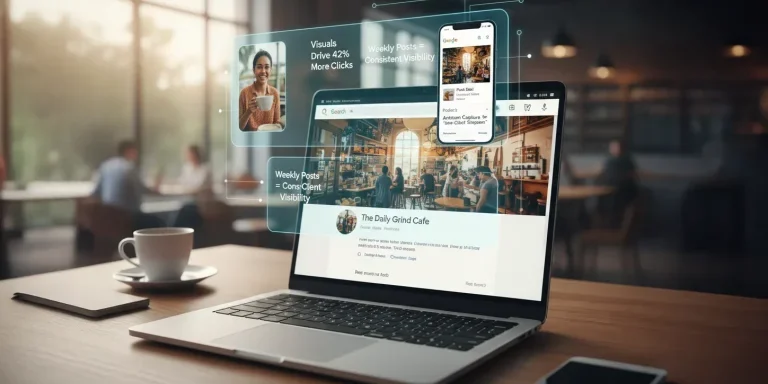
Google Business Profile Optimization: Visuals, Posts & Products That Drive Local SEO
Once your Google Business Profile (GBP) is verified and fully filled out, the next step is engagement and heading into 2026, that’s not optional. Google’s local algorithm now tracks not just what’s on your profile, but how often it’s updated, how visually compelling it is, and how well it answers a searcher’s intent. The businesses…

Bots, Spam, and the Fight for Authenticity: How to Spot & Stop Imposters Online
If your inbox, contact form, or social media comments have been flooded lately with strange messages or suspicious “requests,” you’re not imagining it. AI-driven bots have gone mainstream, and they’re getting disturbingly good at pretending to be real people. Generative AI tools have made it easy for anyone to create automated programs that talk, type,…
Geofencing & How It Attracts Local Customers in Manchester, NH
Are you missing out on customers who pass by your storefront without ever stepping inside? If the answer is yes, there’s a smart solution. It’s called geofencing marketing, and it’s helping businesses in Manchester, NH connect with people right when they’re nearby your store, shop, or outlet. What is Geofencing & How Does It Work?…

Q3 Tariff Update: The Price Increases & Marketing Strategies for 2026
The financial cascade is now complete: Product Categories: The New Winners and Losers Most Challenging Categories Metals & Drinkware: 25-50% tariffs on steel/aluminum continue to devastate traditional favorites Electronics: Consumer tech faces 10-25% increases, though selective exemptions create opportunities Jewelry: The “triple-whammy” of high tariffs, record precious metal prices, and 50% copper tariffs makes this…

2025 Social Media Trends: Strategic Guide for Marketing Success
As we look ahead to social media trends in 2025, businesses need to prepare for significant changes in the digital landscape. These emerging social media trends will reshape how brands connect with their audiences and drive engagement. From evolving platform dynamics to new consumer behaviors, understanding and adapting to these 2025 trends is crucial for…

Social Media ROI Guide: Essential Metrics for Marketing Success
Social media isn’t just about likes and shares anymore. To truly succeed, you need to prove its impact on your bottom line. This guide goes beyond vanity metrics, revealing the essential data points that demonstrate your social media ROI and fuel business growth. Learn how to track, analyze, and optimize your strategy for maximum results.…
How to Build a Consistent Brand Across All Platforms
In today’s crowded marketplace, a strong and consistent brand presence isn’t just an asset—it’s a necessity. Your brand goes beyond a mere logo or visual identity; it embodies your tone of voice, messaging, and the overall experience you offer customers. Crafting a cohesive brand that seamlessly translates from your website to social media and offline…

Data Privacy in Digital Marketing: The Complete Guide for 2025
Picture this: You’re scrolling through your social media feed when an ad pops up for the exact product you were just discussing with a friend. Coincidence? Not quite. Welcome to the world of modern digital marketing, where data drives everything—but at what cost? In today’s digital landscape, data privacy isn’t just another checkbox on your…

The Impact of Branded Holiday Gifts for Employees and Clients
As the holiday season approaches, businesses of all sizes are faced with the annual challenge of selecting meaningful gifts for their employees and valued clients. While some may view corporate gift-giving as a mere formality, savvy business leaders recognize the profound impact that thoughtfully chosen, branded holiday gifts can have on both internal morale and…
Omnichannel Marketing Solutions
Merging creativity and technology for comprehensive brand experiences.

PIXELS
Harnessing digital platforms for impactful brand promotion and audience engagement through strategic touchpoints.

PROMOS
Making the intangible tangible through high-quality promotional items that echo your brand's voice and values.

PLACES
Transforming physical environments into powerful brand narratives that forge connections with everyone who enters your space.