

Holiday SEO Timeline: Why December Rankings Start in Summer
The businesses that dominate search results this December made their move back in July. Not out of habit. They moved early because search rewards steady, consistent work in a way that no last-minute push can replicate.
Holiday SEO is not a campaign you switch on when the decorations come out. It is an advantage you build months before anyone searches for a gift or a service. By November, the businesses that prepared in summer already have pages that are live, crawled, and gaining traction. This holiday SEO timeline is how you build that advantage while it is still summer, and it is the kind of planning our SEO and digital marketing team maps out with clients every year.
When Should Holiday SEO Begin?
Short answer: review and update your seasonal pages during the summer, with your major changes live by late August or September.
THE QUICK ANSWER: Start seasonal SEO work in summer. Get significant updates published by early fall so pages have time to be crawled, linked, and improved before demand peaks. October is late for competitive organic searches, but you can still sharpen existing pages, local listings, internal links, conversion paths, and paid-search support.
The reason for the summer timeline is not superstition. It comes down to how long search actually takes to reward a page, which is the part most business owners underestimate.
Why Holiday SEO in November Is Already Behind?
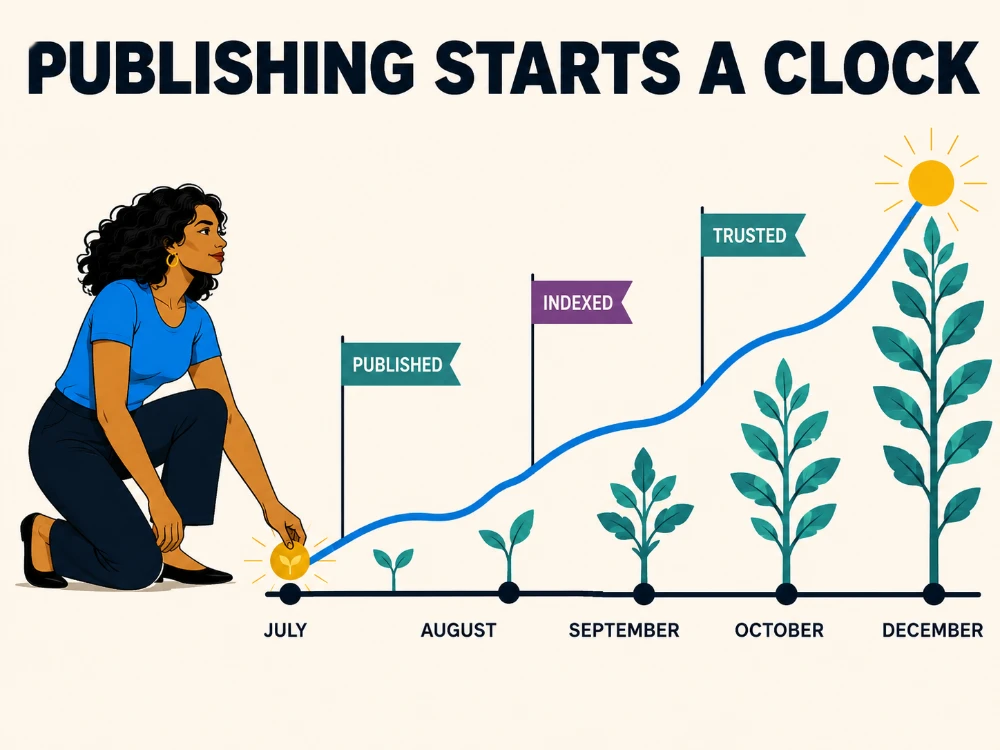
Here is the part most people miss. Publishing a page does not earn you a ranking. It only makes the page eligible to appear in search.
After a page goes live, ranking competitively can take much longer. Google has to recrawl the page, evaluate its relevance and quality, discover the internal and external links pointing to it, and compare it against results that have been in place for years. When a search is competitive and seasonal, meaningful visibility often takes weeks or months rather than days.
A page you publish in November is competing against pages that have been earning links and relevance since spring. For competitive holiday searches, you are not entering the same race. The strongest competitors may already have months or years of momentum.
What Actually Takes Time in Search
On a healthy, established website, Google may discover a new page fairly quickly. Even then, crawling and indexing can still take days or weeks, and neither one is guaranteed. Submitting a URL does not force a ranking.
Large catalogs add their own challenges. Product pages can sit buried deep in the site, get duplicated through filters and parameters, or launch with descriptions that offer little unique value. Those problems get much harder to untangle when an entire seasonal catalog goes live at once in November.
Page age plays a role too, though not the way people assume. Multiple third-party studies have found that many top-ranking pages are several years old. That does not mean Google rewards age by itself. Older URLs have simply had more time to earn links, gather internal support, and prove lasting relevance. The lesson is not “old pages win.” The lesson is that time only rewards a page that keeps improving and attracting links.
Stop Deleting Your Best Pages Every January
This is the most common holiday SEO mistake, and it is one of the easiest to fix.
Every year, a business builds a page like /black-friday-deals-2025, drives traffic to it through the season, then deletes it in January. The next year, they build /black-friday-deals-2026 from scratch. They just threw away every backlink, every internal link, and every ranking signal that page earned. Now they start from zero again.
The fix is a permanent, date-free page. Build one evergreen URL like /black-friday-deals and keep it live all year. In the off-season, it can hold an email sign-up form, a preview of what is coming, or links to related categories. As the season approaches, you update the products, the pricing, and the design. The page keeps everything it earned in past years and builds on it. If you already have several dated versions indexed, consolidate them carefully with permanent redirects rather than simply deleting the old pages, so the value they built carries over.
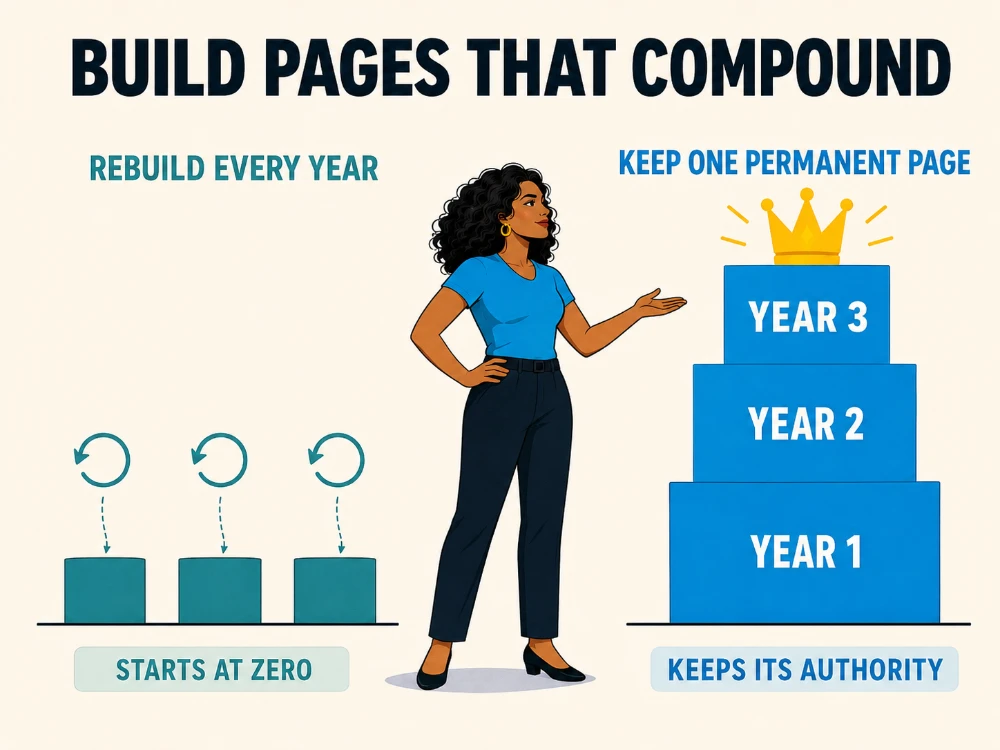
THE PRINCIPLE: Publishing starts the opportunity to be crawled, linked, and improved. Time helps only when the page keeps building relevance and attracting links. A permanent page you improve each year carries its history forward. One you rebuild annually starts over every time.
Pair those permanent pages with a simple linking habit. Your strongest evergreen content, the guides and articles that rank well year-round, should link directly to your seasonal pages using clear, descriptive anchor text. That internal link passes authority to the pages that need it and signals that those seasonal pages matter.
Which Holiday Pages Should You Build?
You do not need dozens of pages. A focused group of pages, built early and kept live, is usually more valuable than dozens of thin seasonal ones. For most businesses, these five cover it:
- An evergreen campaign hub. One permanent page that anchors your seasonal offers and links out to everything else.
- Product or service category pages. The core pages people actually buy or book from, refreshed for the season.
- Gift guides or comparison content. Helpful content that pulls in early researchers and links down to your offers.
- Local holiday landing pages. Location-specific pages for the areas you genuinely serve.
- Logistics pages. Shipping, pickup, returns, hours, and deadline information that answers real buying questions.
And a reminder that holiday SEO is not only for retailers. Service businesses have their own version of this work. An HVAC company can prepare winter repair and tune-up pages. A restaurant can build holiday event and catering pages. Venues and clubs can market holiday parties. Professional services can publish year-end planning content, and contractors can promote seasonal maintenance. The timing principle is identical: get the pages ready before demand arrives.
Holiday Local SEO for Regional Businesses
If your business has a physical location, this is your advantage. National competitors cannot show up in a “near me” search the way you can.
Local search becomes especially important during the holidays as shoppers look for nearby inventory, accurate store hours, pickup options, and businesses they can visit quickly. Many of them check your Google Business Profile before they ever reach your website. If your listing shows last year’s hours or stale photos, you lose them before the conversation starts.
For businesses across New Hampshire, the Seacoast, Southern Maine, and into Metro Boston, the holiday local playbook is straightforward:
- Update your Google Business Profile early. Set accurate holiday hours, refresh your photos, and respond to recent reviews before the rush.
- Keep your business information consistent. Matching name, address, and phone across the web reduces customer confusion and helps search platforms connect you to the right location.
- Build local pages only where they earn their place. A page like “winter tires in Nashua” works when you truly serve Nashua and the page offers distinct information: services, delivery areas, directions, inventory, or local project examples.
- Add accurate LocalBusiness schema where appropriate. It will not create rankings on its own, but it helps search engines understand your business details and location.
One caution. Do not spin up near-identical pages for every nearby city just to chase location keywords. Thin, copied city pages help no one and can work against you. Build a local page only when you can genuinely make it useful.
Preparing Your Brand for AI-Assisted Search
Search is shifting. More people now ask a question and get a synthesized answer from tools like ChatGPT, Gemini, Claude, and Google’s AI Overviews instead of scrolling through ten blue links.
This matters, but the impact is not uniform, and these systems do not work alike. AI-generated answers can change which sources get attention and may reduce traditional organic clicks for some queries. How much depends heavily on your industry and the intent behind the search. Different tools also retrieve and cite sources differently, so there is no single system to optimize for.
Because of that, treat this as emerging best practice rather than a proven formula. There is no universal checklist that guarantees an AI citation. What does help is making your brand easy to understand and verify: clear factual content, original case studies with real numbers, reputable third-party mentions, transparent authorship, consistent business information, and strong traditional SEO. Brandit uses these tools in active marketing workflows, but the practical lesson stays the same: make your business easy to understand, verify, and cite. That kind of credibility builds over months, and you cannot manufacture it in November.
Your Summer Holiday SEO Checklist
Here is how to put all of this into practice without a 40-page strategy document. Work through it by month and you will be ready long before your competitors wake up.
July: Audit and Plan
- Find last year’s seasonal pages and confirm they live at permanent, date-free URLs.
- Review last year’s Search Console data, seasonal keyword trends, customer questions, and current search results to identify what people are likely to need this year.
- Check site performance now. Slow pages frustrate shoppers, weaken conversions, and get less reliable as traffic climbs. This is also the right time to complete a broader website performance audit so technical weaknesses are not discovered during peak traffic.
- Avoid major site migrations, navigation overhauls, or platform changes immediately before the holiday season whenever possible. Significant URL changes can create temporary ranking fluctuations while search systems recrawl and process the new structure.
August: Build and Refresh
- Refresh your evergreen hubs and guides so they have weeks to be crawled and evaluated.
- Add internal links from your strongest year-round content to your seasonal pages.
- Write original descriptions instead of pasting the manufacturer copy everyone else uses.
September: Localize and Polish
- Set your holiday hours in Google Business Profile and confirm your listings match across the web.
- Launch any new local landing pages so they get indexed before demand spikes.
- Confirm your analytics track conversions correctly before the traffic arrives.
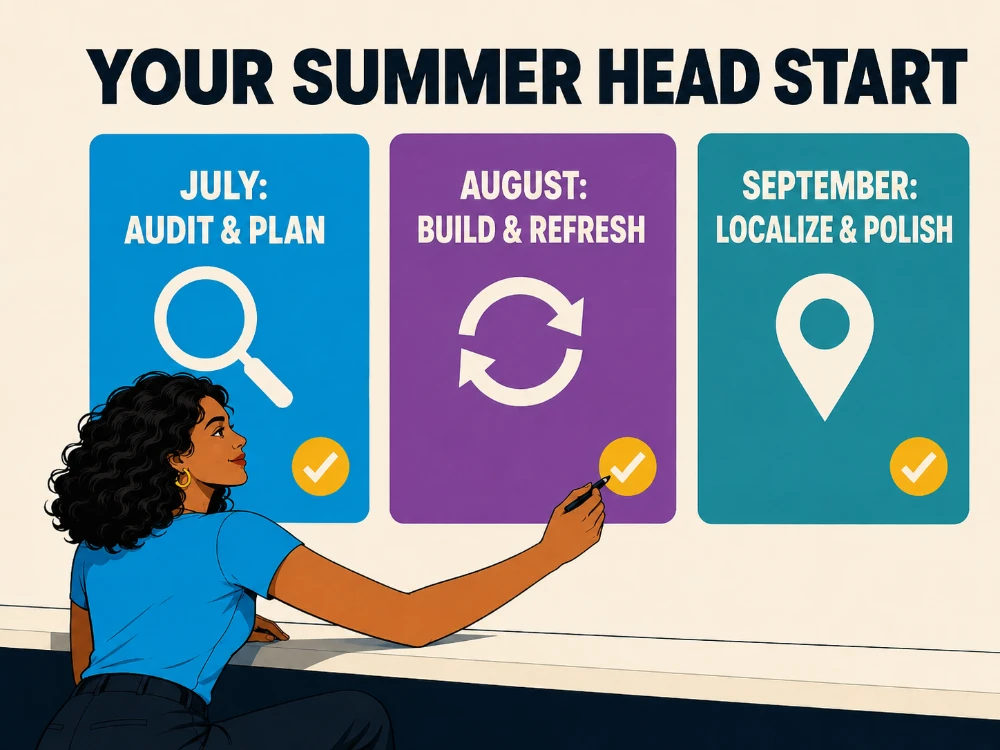
Follow that rhythm and November becomes a month of small adjustments instead of a desperate sprint. Your pages are already live, already crawled, and already building relevance before demand peaks.
Holiday SEO Questions, Answered
When should holiday SEO begin?
Ideally, review and update your seasonal pages during the summer, with major changes live by late August or September. That gives search time to crawl and evaluate them before demand peaks.
Should holiday pages stay live all year?
In most cases, yes. Keep useful seasonal URLs active and update the content each year rather than deleting and rebuilding the page. That preserves the links and history the page has earned.
Is October too late for holiday SEO?
It is late for highly competitive organic searches. You can still make real gains by improving existing pages, local listings, internal links, conversion paths, and paid-search support.
How long does SEO take to work?
There is no fixed timeline. Results depend on competition, your site’s authority, content quality, technical condition, and how well the page is linked and promoted. That is exactly why starting early matters.
Build Next December’s Rankings This Summer
Holiday SEO rewards businesses that treat search as a year-round asset rather than a seasonal scramble. If you want a clear plan mapped to your products or services, your region, and your timeline, that is exactly the kind of work our PIXELS team does every day.
Summer creates the time to research, build, test, and improve. Early fall creates the time to validate, connect, and promote. The holiday season then becomes a period of controlled updates rather than emergency repairs.
If you need a holiday SEO strategy mapped to your services, products, locations, and commercial goals, Brandit can connect content planning, technical SEO, local search, paid media, website performance, and conversion tracking.
Ready to own your search results this December? Let’s talk about your holiday plan while there is still time to build a real head start.
- When Should Holiday SEO Begin?
- Why Holiday SEO in November Is Already Behind?
- What Actually Takes Time in Search
- Stop Deleting Your Best Pages Every January
- Which Holiday Pages Should You Build?
- Holiday Local SEO for Regional Businesses
- Preparing Your Brand for AI-Assisted Search
- Your Summer Holiday SEO Checklist
- Holiday SEO Questions, Answered
- Build Next December’s Rankings This Summer
Ready to Take Your Brand Beyond Ordinary?
Your marketing shouldn’t just exist. It should perform. If you’re done settling for “good enough,” let’s build something impossible to ignore. Brandit helps you connect every digital, physical, and promotional touchpoint into one unstoppable brand experience.
Real Results,
Real Reactions
What Our Clients Say

"I sent out three bids for my marketing needs for this year and Brandit was the most responsive and provided great ideas. One company I reached out hadn't even gotten back to me while the other wasn't even close to being comparable to Brandit's creativity, pricing and service."
"I have used Brandit for several projects and they always come through with fantastic pricing and customer service. I highly recommend them."
Southern New Hampshire University

"Thanks to Brandit's generous contribution to the Big Ideas for Building Independence Capital Campaign, Easterseals NH is now better able to serve people with disabilities or special needs. With your support, we raised nearly $2.6 million for renovations to our headquarters."
"It has been an incredible journey! We couldn't have done it without you, and wish to take this opportunity to thank you and your team at Brandit Marketing Solutions for all that you have done and your generous donation."
Easterseals, NH

"Bringing Brandit Marketing Solutions into the CMC-fold is the best thing and most appreciative thing I've done since being at the Hospital."
Catholic Medical Center
"Exceptional does not even begin to cover the work that these people do. I have worked closely with other marketing firms and Brandit tops them every time. From innovative ideas to customer service that rivals the best of the best. I just couldn't speak more highly of them."
Southern New Hampshire University

"The Granite Group, headquartered in Concord, NH, distributes plumbing, heating, cooling, water and propane supplies to contractors and fuel dealers across New England through over 45 wholesale branches and their Online Store. The company also operates 15 retail showrooms under The Ultimate Bath Store name.
Brandit is pleased to say that we have been working with the Granite Group for over ten years which happens to be almost as long as this company has been in existence. In 2020, TGG was named one of New Hampshire's best places to work."
The Granite Group
10+ Year Partnership

"Over my long career, I have been in a position where I have worked closely with numerous vendors/suppliers. I can honestly say that I have never engaged with a company that is as amazing and responsive as Brandit."
"A sincere thanks to the team for the hustle on getting our shirts and tradeshow materials done for our group! You really relieved our pressure and I know it wasn't an easy task. Your effort and turnaround time was and is appreciated. Believe me when I say that I do not take for granted the relationship we have built over the years. Your service is top notch."
C&S Wholesale Grocers

"For almost a decade, the team at Brandit delivered successful and effective marketing solutions, spearheaded the merchandising of the FIRST brand by creating one-of-a-kind products, built, hosted, and managed their very first ecommerce store supporting all programs, staff, partners, sponsors, teams, and customers globally.
In addition, Brandit set up and managed multiple on-site retail stores at their premier Championship events where we serviced over 65,000 attendees. Today we provide web services as well as branded merchandise for regional partners".
FIRST Robotics

"The Brandit Marketing Solutions Ltd Team is wonderful to work with and we appreciate what they do to make us look good! They have expanded their services in recent years to meet whatever marketing needs you may have…from apparel and giveaway items to video and web services to graphic design and printing services, even graphic enhancements for your interior/exterior office space."
"I have worked with this team since the founding of their company and look forward to many more years of working together!"
Boys & Girls Club of Manchester

"The Brandit team is a talented group of creative professionals that I've worked with for years. Top notch!"
Art Murphy
Our Insights
.
Brand Consistency: Make Your Site & Sign Match
Your website looks sharp. Your storefront sign looks fine. Your business cards came back a slightly different shade of blue than you remembered. Each one on its own seems like a small thing. Together, they cost you customers and money. Brand consistency is whether everything a customer sees from you looks and sounds like it…

Sustainable Promotional Products: A Buyer’s Reality Check
That recycled tote you ordered for the trade show has a problem. The product page called it eco-friendly, you felt good about the choice, and you moved on. Here is the uncomfortable part: when auditors actually test merchandise carrying self-declared green labels, close to half cannot back up the claim. The word on the page…
What Is AI Search Readiness and How Can Local Businesses Improve Visibility?
Your next lead may begin with an AI agent researching your company before a person ever visits your website or contacts your team. Google is expanding the ways its AI-powered Search tools can help people find and compare local providers. A customer can describe what they need, ask Google to research nearby businesses, and use…
Premium vs. Volume: Rethinking Your Promotional Products Budget
You order 500 pens for the trade show. They cost a little over a dollar each, they have your logo, and they feel like a responsible use of the budget. Three weeks later, most of them are in a junk drawer, a parking lot, or a trash can. A few never made it out of…

Corporate Holiday Gifting Timeline: Why Q4 Planning Starts in July
Here is the part nobody tells you about corporate gifting: the best time to lock in your holiday program is right now, in July. Not October. Not “right after Halloween.” July. That sounds early enough to be a joke. It is not. The companies that run corporate gifting well, sending memorable and on-time gifts to…

Website Performance Audit: Why Q3 Beats Q4 Every Time
Your website traffic is about to drop. Vacations start, inboxes go quiet, and the steady hum of summer browsing replaces the urgency of buying season. Most businesses read that slowdown as a reason to coast. That is the expensive mistake. The quiet stretch from July through September is the best window all year to run…

Summer Foot Traffic: Win It With a Mobile-First Website
Picture a family on a sidewalk in Portsmouth on a Saturday in July. It is 86 degrees, the kids are hungry, and someone pulls out a phone and types “lunch near me.” Three places show up on the map. They tap the first one. If that site loads fast and the menu is right there,…

Modern Phishing Scams: What Smart Businesses Need to Know
The old advice for spotting a scam email no longer works. Watch for bad spelling, awkward grammar, and a generic greeting, and you were safe. That rule protected people for years. Modern phishing scams have erased every one of those tells. Attackers now write clean, personalized messages, hide their links inside images, and move the…

Branded Koozies and Sunglasses Aren’t Lazy: High-Yield Summer Promotional Products
Someone on your team just rolled their eyes at the idea of branded sunglasses. Too obvious. Too expected. Let’s do something clever instead, maybe a little desk gadget or a puzzle nobody asked for. That instinct feels smart. It usually costs you the campaign. Here’s the part most people miss: the “clever” item lives on…

Stale Service Pages Tell Google You’ve Closed. Here’s How to Tell It You Haven’t
Your phone used to ring. Then it slowed. Now your top service page sits on page two of Google, and you have no idea why. Nothing is broken. Your site loads. Your contact form works. Your services are the same ones you offered last year, and the year before that. So what changed? Probably nothing…
Omnichannel Marketing Solutions
Merging creativity and technology for comprehensive brand experiences.

PIXELS
Harnessing digital platforms for impactful brand promotion and audience engagement through strategic touchpoints.

PROMOS
Making the intangible tangible through high-quality promotional items that echo your brand's voice and values.

PLACES
Transforming physical environments into powerful brand narratives that forge connections with everyone who enters your space.