

Corporate Holiday Gifting Timeline: Why Q4 Planning Starts in July
Here is the part nobody tells you about corporate gifting: the best time to lock in your holiday program is right now, in July. Not October. Not “right after Halloween.” July.
That sounds early enough to be a joke. It is not. The companies that run corporate gifting well, sending memorable and on-time gifts to their best clients, employees and referral partners every December, made their key decisions by mid-summer. The ones scrambling in November pay more, get less and watch their gifts arrive to empty offices the week of Christmas. The gap between those two outcomes is not budget. It is timing.
Quick answer: companies should start planning corporate holiday gifts in July, or about 12 to 20 weeks before the desired delivery date. Use July for the recipient list, budget, vendor conversations, gift direction and samples; August for artwork, packaging and production approval; September and October for production, kitting and address verification; and November for controlled shipping.
The short version: custom gift production runs on lead times, supplier capacity fills quickly and holiday shipping costs can change as carriers move into peak demand periods. Plan in summer and you control more of the process. Wait until fall and the calendar starts making decisions for you.
Why Corporate Holiday Gifting Falls Apart in Q4?
The fourth quarter is already the busiest stretch of the year. You are closing the books, renewing contracts, running performance reviews, and trying to hit your numbers. Gifting gets shoved to the bottom of the list until someone realizes in mid-November that the holidays are three weeks out and nothing has been ordered.
By then, three things have already gone wrong. The good vendors are booked solid. The shipping carriers have switched on their peak-season pricing. And your window to verify addresses, handle customs, and actually get gifts delivered before offices empty out has shrunk to almost nothing.
None of this is bad luck. It is a predictable cycle that repeats every single year. Once you see the calendar behind it, you can plan around it instead of getting caught in it.
The August Wall: the deadline that decides everything
If you remember one date from this entire article, make it August 15.
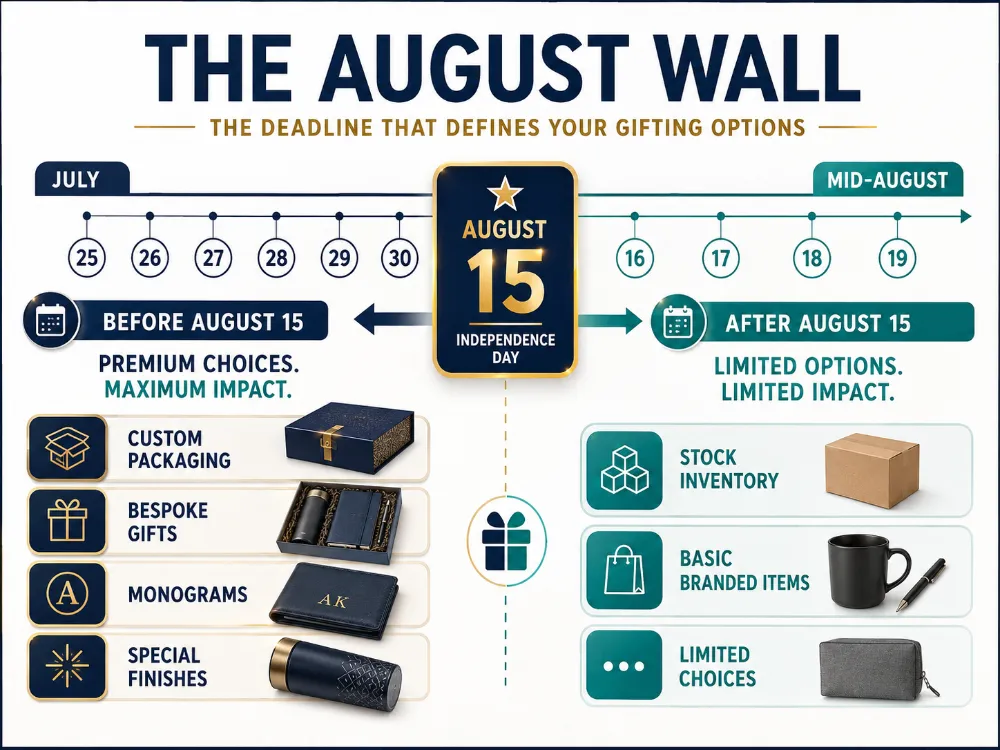
Around the middle of August, high-end production studios lock their calendars for the rest of the year. Think hand-blown glass, custom leather goods, bespoke ceramics, the kind of gifts that actually get kept instead of tossed in a drawer. After that date, those makers are heads-down filling retail orders for the holiday rush, and they stop taking new custom work.
Order before the wall and you get real customization: your dimensions, your finishes, your branding done right. Order after it and you are picking from whatever standard inventory is already sitting in a warehouse. You can still get a logo printed on it, but the structural customization is gone. No custom sizing, no premium finishes, no special interior packaging.
This is why summer matters so much. The work you do in July, while there is still room to customize, is what earns you a spot before the wall goes up.
How Much Lead Time Does Each Corporate Gift Type Need?
Not every corporate gift needs the same runway. A digital reward program does not need the same timeline as a custom manufactured product, and an in-stock branded item does not carry the same risk as an international food gift. This is where many Q4 programs go sideways: the team talks about “corporate gifting” as if it is one category, when it is really several different production and fulfillment paths.
| Gift Type | Planning Complexity | Key Timing Factors | Recommended Approval Window |
|---|---|---|---|
| Fully custom manufactured products | High | Prototypes, materials, overseas production, freight and quality control | Summer approval whenever possible |
| Custom gift boxes and kitting | Medium-high | Product sourcing, inserts, packaging, assembly and fulfillment | July or August for the smoothest program |
| Decorated apparel | Medium | Sizing, inventory, embroidery, screen printing or heat transfer | August or September, depending on quantity and decoration |
| In-stock branded merchandise | Medium | Inventory availability, artwork proofing and decoration capacity | September can work; October may require simplification |
| Food, beverage or perishable gifts | High | Shelf life, temperature, allergies, state rules and delivery scheduling | Late summer or early fall, with extra review |
| International gifts | High | Customs, duties, restricted items, address formats and local holidays | Start early and add a larger shipping buffer |
| Recipient-choice or digital gifts | Low-medium | Platform setup, messaging, claim windows and reporting | Useful when timing is tight or preferences vary |
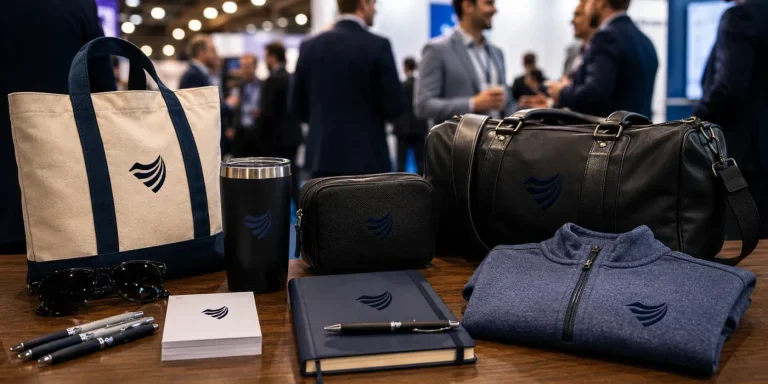
If your program includes multiple products, custom packaging or direct-to-recipient delivery, Brandit’s custom promotional kitting services can help turn all those moving parts into one coordinated campaign. For programs that need branded boxes, inserts, packing, storage and shipment control, custom packaging and fulfillment should be part of the timeline conversation from the beginning.
Corporate Gifting Timeline: The month-by-month plan that keeps you ahead
You do not need a complicated system. You need a backward-planned calendar that treats each month as a checkpoint. Here is the version that works for most businesses planning Q4 client gifts, employee gifts, executive gifts, referral gifts or partner appreciation programs.
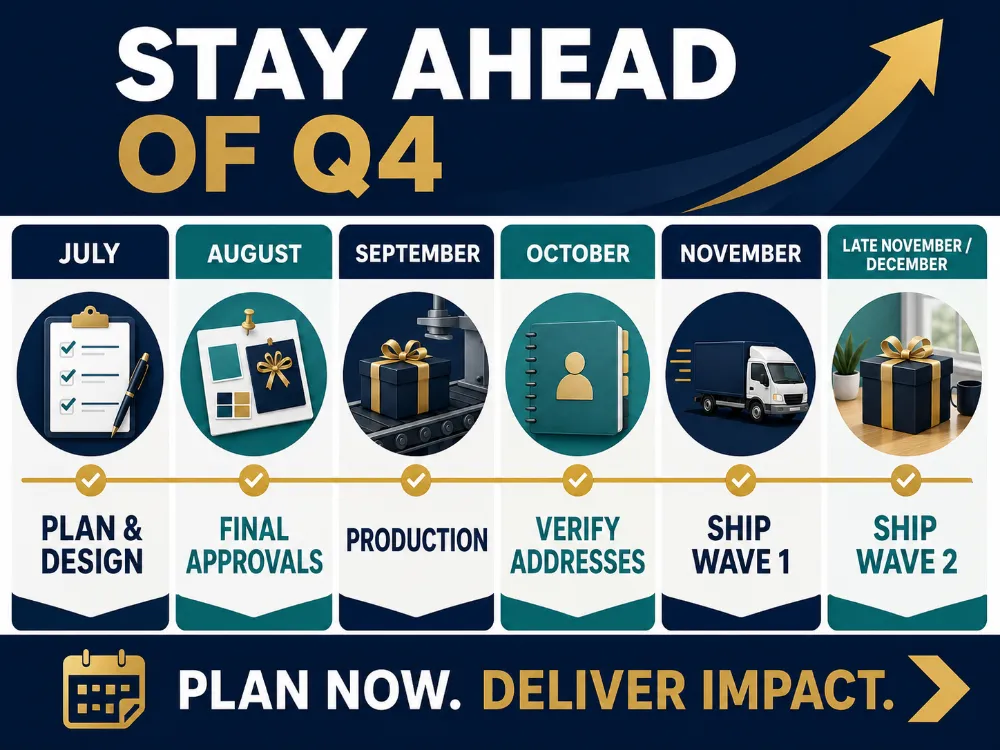
1. July: set the plan and lock the design
If you have not already named your recipients and set a budget, do it now, then keep moving in the same week. Get your people in a room. Sales, HR, marketing, whoever owns relationships. Agree on the kind of gift you want to send, approve the design, sign off on custom packaging, and request samples.
Businesses that commit in July routinely save 10 to 15 percent compared to fall pricing, because materials are cheaper and vendor capacity is wide open. Same gift, smaller bill, just for moving early.
July is also the right time to define the business objective. Are you trying to protect renewals, thank top accounts, recognize employees, re-engage dormant customers or support a sales follow-up? The answer changes the recipient list, budget tiers, message and measurement plan.
For branded merchandise, apparel and promotional products, start with the destination the gift needs to serve. Brandit’s promotional products and apparel services are most useful when the gift is tied to a relationship goal, not chosen as a random object with a logo on it.
2. August: Approve Samples, Artwork and Production
The first two weeks of August are your final prep window. Every custom approval, every monogram spec, every packaging prototype needs to be signed off before August 15. Miss it and your options shrink to stock inventory.
Miss this window and your options may shrink. You may still be able to produce a strong gift, but the route often changes from deep customization to lighter branding, available inventory or simpler packaging. That is not failure. It is just a different strategy.
This is also when brand consistency matters. Logo placement, color, materials, insert cards, packaging copy and the unboxing sequence should feel like the same company across every touchpoint. If your team needs a gut check on that side of the work, Brandit’s guide to building a consistent brand across all platforms is a useful companion.
3. September: Begin Production and Collect Addresses
Your gifts are being made and checked for quality. Meanwhile, you start the unglamorous but critical work of gathering accurate shipping addresses for everyone on your list.
For employee gifting, this may require home-address consent, size collection and HR review. For client gifting, account owners may need to confirm recipient names, office schedules and gift-acceptance policies. For prospects, sales should coordinate the gift with a thoughtful follow-up plan instead of letting a box arrive without context.
If the program includes employees, Brandit’s employee recognition and appreciation services can help shape the gift around morale, retention and culture rather than treating it as another holiday errand.
4. October: Verify Addresses and Finalize Shipping
By October 15, every address should be verified and final. This is also when you prepare any customs paperwork for international recipients and map out your shipping schedule.
Bad addresses trigger correction fees, failed deliveries and awkward follow-up. Validating addresses at the moment someone enters them, rather than discovering the typo after the box bounces back, saves money and embarrassment. If you are collecting home addresses, keep the process respectful: explain why the information is needed, limit access and avoid storing more recipient data than the campaign requires.
5. November and December: Ship, Track and Resolve Exceptions
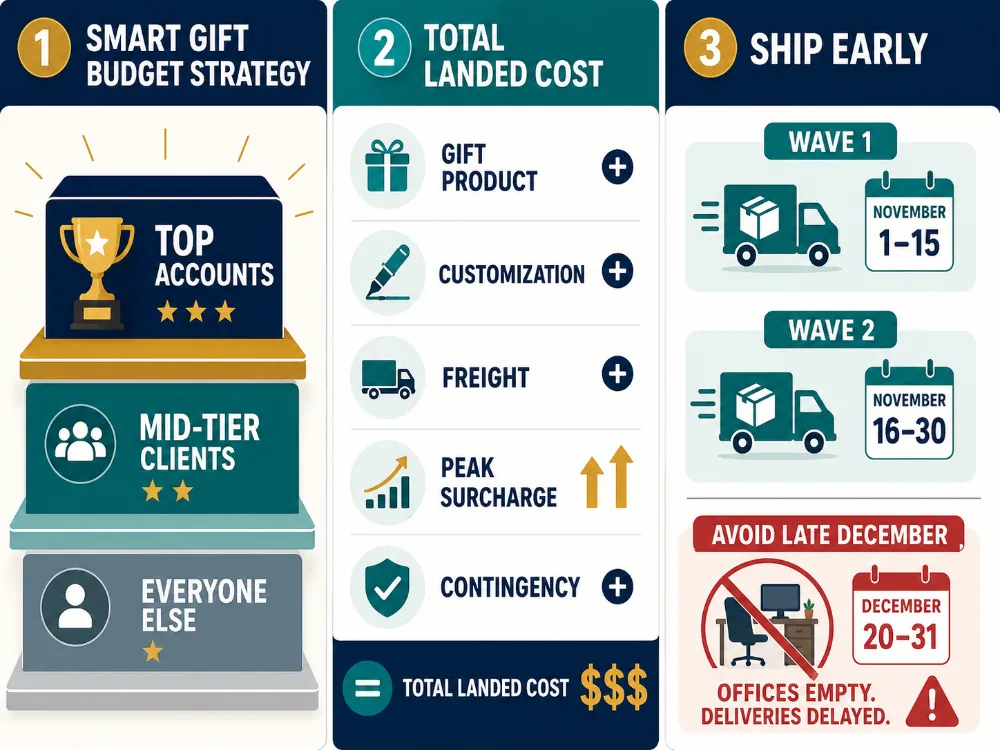
Send the first wave in early November so it lands before Thanksgiving. Send the second wave in late November so everything arrives by around December 20. That timing gets your gift onto a desk before the recipient’s office turns into a ghost town. Avoid the December 21 to January 2 dead zone entirely, when packages sit in empty lobbies and get returned, lost, or swiped.
Quick gut check: If you are reading this in July, you are right on time, with a few weeks to customize before the August Wall closes your best options. If you are reading it in October, skip the custom route, go with quality stock items you can brand fast, and focus everything on getting addresses locked and gifts shipped before mid-December.
What Should Late Planners Do?
If you are reading this in July, you are right on time. If you are reading it in October or November, do not panic-order the most complicated idea on the list. Change the strategy to match the time available.
| When Planning Begins | Most Realistic Route |
|---|---|
| July–August | Full customization, samples, custom packaging, kitting and international options |
| September | Branded inventory, custom kits, standard personalization and domestic fulfillment |
| October | In-stock merchandise, simplified packaging, limited recipient lists and faster decoration |
| November | Ready-to-ship gifts, local delivery, digital choice programs or handwritten outreach |
| December | Digital rewards, experiences, charitable gifts or a New Year appreciation campaign |
Digital rewards can be especially useful when the recipient list is distributed, preferences vary or delivery timing is already tight. Brandit’s digital rewards programs give late planners a practical alternative when physical production and shipping windows have narrowed.
How to Allocate a Corporate Gifting Budget?
Most gifting budgets get spread flat across every contact, which means your most important client gets roughly the same gift as someone you met once at a trade show. That is a waste of money in both directions.
A smarter approach ties your spend to the value and purpose of the relationship. One model that works well splits the budget across tiers:
- Your top accounts get the largest share. These are the handful of clients who drive most of your revenue, and a well-chosen gift here protects renewals worth far more than the gift itself.
- Your solid mid-tier clients get a meaningful but more modest gift. Steady revenue, good growth potential, worth real appreciation.
- Everyone else splits the rest. Newer relationships, referral partners, and your own team for employee recognition.
The math is the point. A thoughtful, well-timed gift to a key decision-maker can directly shape a contract renewal worth thousands. Spending more where it counts is not extravagance. It is return on investment.
If your goal is client retention or appreciation, Brandit’s customer engagement and appreciation services connect gifting to the bigger relationship strategy. For more background on why branded gifts can matter to both employees and clients, see Brandit’s article on the impact of branded holiday gifts.
How to Calculate Shipping and Total Landed Cost?
Here is the mistake that catches almost everyone: budgeting off the product price and forgetting what it costs to actually deliver the thing.
- From late November through the end of December, the major carriers add peak-season surcharges on top of normal rates. Residential deliveries cost more. Oversized and oddly shaped packages cost a lot more. And these fees stack on a single shipment.
- A large, nonstandard package shipped during the peak window can carry a base rate of around 14 dollars, then collect a peak surcharge plus an oversize fee that pushes the real cost north of 120 dollars. That is nearly nine times the base rate, on one box. Send a thousand of those and you have added six figures in shipping fees you never planned for.
There are two ways to avoid this. First, plan early enough to use standard ground shipping instead of getting forced into expensive air freight to hit a deadline. Second, build your budget around total landed cost, not the sticker price. That means adding up the product, the setup and customization fees, the freight, the peak surcharges, and a contingency buffer of around 10 percent for late additions and delivery hiccups. The number you get is what the campaign actually costs. Plan against that one.
Carriers may introduce seasonal demand surcharges, temporary price changes and additional package fees during periods of elevated volume. Those dates, affected services and fee amounts change by carrier and year. Before finalizing a Q4 gifting budget, check the current guidance from UPS demand surcharges, FedEx demand surcharges, the FedEx holiday shipping schedule and the USPS price-change page.
Do not plan against the unit cost alone. Plan against total landed cost:
Total landed cost = product + setup + customization + packaging + kitting + freight + carrier surcharges + address corrections + duties or taxes + contingency.
Oversized packages, residential deliveries, expedited services, remote-area destinations, fuel surcharges and address corrections can all affect the real number. If imported products are part of the program, tariffs and product availability may also influence the final cost. Brandit’s article on tariffs and branded merchandise planning is worth reviewing when sourcing decisions depend on overseas production.
Make it easy on yourself: Recipient choice, addresses, and Gift Compliance
A couple of practical moves remove most of the headaches that come with sending gifts at scale.
- Let Recipients Choose When Preference Matters – Modern gifting platforms let you set a budget and send recipients a curated menu to pick from. This solves several problems at once. You do not have to guess their taste, you never need their home address up front because they enter it when they claim the gift, and you sidestep dietary and allergy landmines entirely. People who choose their own gift are far more likely to actually want it.
- Verify addresses before you ship – Bad addresses trigger correction fees and failed deliveries. Validating them at the moment someone enters them, rather than discovering the typo after the box bounces back, saves money and embarrassment.
- Separate Client, Employee and Regulated-Industry Rules – Client gifts, employee gifts and public-sector or regulated-industry gifts should not be treated as one compliance bucket. Clients may have gift-acceptance policies. Employees may trigger payroll or fringe-benefit considerations. Healthcare, finance and government recipients may face stricter value limits or approval rules. International programs may also require anti-bribery, customs and company-policy review.
The IRS says business gift deductions are generally limited to $25 per recipient per tax year, and notes that incidental costs such as engraving, packing or shipping may be treated separately when they do not add substantial value to the gift. See the IRS business gift FAQ for the federal baseline. Employee gifts can follow different rules, and the IRS fringe benefit guide should be reviewed with whoever handles payroll, tax or legal compliance.
That is not the fun part of gifting, but it is the part that keeps a kind gesture from becoming a problem.
International Corporate Gifting Considerations
International gifts need extra room on the calendar. Customs declarations, duties, taxes, restricted items, alcohol rules, food import limits, local holidays, recipient phone numbers and address formatting can all affect delivery.
If the recipient list crosses borders, decide early whether you will ship from the United States, use local fulfillment partners or choose a digital or recipient-choice alternative. Local fulfillment can reduce customs friction, while digital rewards can avoid the physical delivery problem entirely. The best option depends on the relationship, the gift value, the country and the message you want the recipient to feel.
How You Will Know the Corporate Gifting Program Worked?
Gifting does not have to be a soft expense you justify with vague good feelings. You can measure it on three timelines.
In the first couple of weeks, track whether gifts actually reached people and how many recipients engaged, claimed or acknowledged the gift. Over the next few months, watch whether gifted clients renew at a higher rate than comparable ungifted accounts, and whether prospects who received a gift booked more meetings. Over a full quarter and beyond, look at renewal lift, referral activity and, for internal programs, employee sentiment or retention signals.
| Objective | Metric | Tracking Method |
|---|---|---|
| Client retention | Renewal rate among gifted accounts | CRM cohort comparison |
| Pipeline acceleration | Meetings booked after delivery | Gift campaign tag and attribution window |
| Customer reactivation | Dormant accounts reopened | CRM stage movement |
| Employee recognition | Claim rate, satisfaction or participation | HRIS note, survey or program report |
| Operational performance | On-time and successful delivery rate | Fulfillment dashboard |
| Budget control | Actual landed cost versus plan | Final campaign reconciliation |
Numbers like these turn gifting from a cost you defend into a program you can improve. The same principle applies across promotional products more broadly; useful, visible and well-timed branded items work best when they are tied to a clear behavior or relationship outcome. Brandit’s promotional products marketing guide explains that bigger picture.
Corporate Gifting Planning Checklist
You do not need to solve the whole program today. You need to start the clock.
- Block 30 minutes to draft a rough recipient list and top-line budget.
- Sort the list into tiers so your spend follows the relationships that matter most.
- Define the goal for each group: retention, appreciation, recognition, prospecting or referral growth.
- Pick one internal person with final sign-off authority so design approvals do not stall in committee.
- Start a sourcing conversation before custom production and packaging options narrow.
- Confirm whether procurement, finance, HR, legal or brand approval is needed.
- Plan against total landed cost, not only product price.
- Collect recipient preferences, sizes, dietary needs and shipping details early.
- Verify addresses before fulfillment begins.
- Track delivery, engagement and business outcomes after the gifts land.
That is it. A handful of moves in July, and you have already put yourself ahead of nearly every competitor who will be panic-ordering in November.
Frequently Asked Questions
When should companies begin planning corporate holiday gifts?
Companies should begin planning corporate holiday gifts in July, or about 12 to 20 weeks before delivery. Custom products, complex packaging, large recipient lists and international shipments need the most lead time.
How long do custom corporate gifts take to produce?
Lead time depends on whether the product is in stock, decorated, assembled into a kit or manufactured to specification. Confirm product, packaging, proof approval, production and fulfillment timelines separately before approving the program.
Is October too late to order corporate holiday gifts?
October may still work for in-stock merchandise, simplified branding, ready-to-ship gifts, local delivery or digital rewards. It is often too late for complex custom production, overseas manufacturing or highly customized packaging without substitutions or rush costs.
When should corporate holiday gifts be delivered?
Most businesses should aim for delivery before recipients begin taking year-end leave. The best window depends on recipient location, office schedule, shipping service, holiday closures and whether the gift supports an event, renewal or recognition moment.
Are corporate gifts tax-deductible?
Business gifts may be subject to federal deduction limits and documentation rules. The IRS generally limits business gift deductions to $25 per recipient per tax year, with some incidental costs treated separately. Employee gifts and cash-equivalent gift cards can follow different rules, so confirm the current treatment with a qualified tax professional.
What should a company do if it misses the ordering deadline?
Use available inventory, simplify packaging, reduce the recipient list, choose a recipient-choice program, send a digital reward or reposition the campaign as a New Year appreciation program.
Plan Your Q4 Corporate Gifting Program With Brandit
Thoughtful corporate gifting is one of the most underused relationship tools a business has, and it only works when the planning starts early. Brandit has spent more than 50 years helping New Hampshire, Southern Maine and Boston-area businesses turn promotional products and corporate gifting programs into real brand moments, from sourcing and custom packaging to kitting and delivery.
If you want help building a Q4 gifting plan that lands on time and on budget, let’s talk it through before the summer window closes.
- Why Corporate Holiday Gifting Falls Apart in Q4?
- The August Wall: the deadline that decides everything
- How Much Lead Time Does Each Corporate Gift Type Need?
- Corporate Gifting Timeline: The month-by-month plan that keeps you ahead
- What Should Late Planners Do?
- How to Allocate a Corporate Gifting Budget?
- How to Calculate Shipping and Total Landed Cost?
- Make it easy on yourself: Recipient choice, addresses, and Gift Compliance
- International Corporate Gifting Considerations
- How You Will Know the Corporate Gifting Program Worked?
- Corporate Gifting Planning Checklist
- Frequently Asked Questions
- Plan Your Q4 Corporate Gifting Program With Brandit
Ready to Take Your Brand Beyond Ordinary?
Your marketing shouldn’t just exist. It should perform. If you’re done settling for “good enough,” let’s build something impossible to ignore. Brandit helps you connect every digital, physical, and promotional touchpoint into one unstoppable brand experience.
Real Results,
Real Reactions
What Our Clients Say

"I sent out three bids for my marketing needs for this year and Brandit was the most responsive and provided great ideas. One company I reached out hadn't even gotten back to me while the other wasn't even close to being comparable to Brandit's creativity, pricing and service."
"I have used Brandit for several projects and they always come through with fantastic pricing and customer service. I highly recommend them."
Southern New Hampshire University

"Thanks to Brandit's generous contribution to the Big Ideas for Building Independence Capital Campaign, Easterseals NH is now better able to serve people with disabilities or special needs. With your support, we raised nearly $2.6 million for renovations to our headquarters."
"It has been an incredible journey! We couldn't have done it without you, and wish to take this opportunity to thank you and your team at Brandit Marketing Solutions for all that you have done and your generous donation."
Easterseals, NH

"Bringing Brandit Marketing Solutions into the CMC-fold is the best thing and most appreciative thing I've done since being at the Hospital."
Catholic Medical Center
"Exceptional does not even begin to cover the work that these people do. I have worked closely with other marketing firms and Brandit tops them every time. From innovative ideas to customer service that rivals the best of the best. I just couldn't speak more highly of them."
Southern New Hampshire University

"The Granite Group, headquartered in Concord, NH, distributes plumbing, heating, cooling, water and propane supplies to contractors and fuel dealers across New England through over 45 wholesale branches and their Online Store. The company also operates 15 retail showrooms under The Ultimate Bath Store name.
Brandit is pleased to say that we have been working with the Granite Group for over ten years which happens to be almost as long as this company has been in existence. In 2020, TGG was named one of New Hampshire's best places to work."
The Granite Group
10+ Year Partnership

"Over my long career, I have been in a position where I have worked closely with numerous vendors/suppliers. I can honestly say that I have never engaged with a company that is as amazing and responsive as Brandit."
"A sincere thanks to the team for the hustle on getting our shirts and tradeshow materials done for our group! You really relieved our pressure and I know it wasn't an easy task. Your effort and turnaround time was and is appreciated. Believe me when I say that I do not take for granted the relationship we have built over the years. Your service is top notch."
C&S Wholesale Grocers

"For almost a decade, the team at Brandit delivered successful and effective marketing solutions, spearheaded the merchandising of the FIRST brand by creating one-of-a-kind products, built, hosted, and managed their very first ecommerce store supporting all programs, staff, partners, sponsors, teams, and customers globally.
In addition, Brandit set up and managed multiple on-site retail stores at their premier Championship events where we serviced over 65,000 attendees. Today we provide web services as well as branded merchandise for regional partners".
FIRST Robotics

"The Brandit Marketing Solutions Ltd Team is wonderful to work with and we appreciate what they do to make us look good! They have expanded their services in recent years to meet whatever marketing needs you may have…from apparel and giveaway items to video and web services to graphic design and printing services, even graphic enhancements for your interior/exterior office space."
"I have worked with this team since the founding of their company and look forward to many more years of working together!"
Boys & Girls Club of Manchester

"The Brandit team is a talented group of creative professionals that I've worked with for years. Top notch!"
Art Murphy
Our Insights
.

Brand Consistency: Make Your Site & Sign Match
Your website looks sharp. Your storefront sign looks fine. Your business cards came back a slightly different shade of blue than you remembered. Each one on its own seems like a small thing. Together, they cost you customers and money. Brand consistency is whether everything a customer sees from you looks and sounds like it…

Sustainable Promotional Products: A Buyer’s Reality Check
That recycled tote you ordered for the trade show has a problem. The product page called it eco-friendly, you felt good about the choice, and you moved on. Here is the uncomfortable part: when auditors actually test merchandise carrying self-declared green labels, close to half cannot back up the claim. The word on the page…
What Is AI Search Readiness and How Can Local Businesses Improve Visibility?
Your next lead may begin with an AI agent researching your company before a person ever visits your website or contacts your team. Google is expanding the ways its AI-powered Search tools can help people find and compare local providers. A customer can describe what they need, ask Google to research nearby businesses, and use…
Premium vs. Volume: Rethinking Your Promotional Products Budget
You order 500 pens for the trade show. They cost a little over a dollar each, they have your logo, and they feel like a responsible use of the budget. Three weeks later, most of them are in a junk drawer, a parking lot, or a trash can. A few never made it out of…

Holiday SEO Timeline: Why December Rankings Start in Summer
The businesses that dominate search results this December made their move back in July. Not out of habit. They moved early because search rewards steady, consistent work in a way that no last-minute push can replicate. Holiday SEO is not a campaign you switch on when the decorations come out. It is an advantage you…

Website Performance Audit: Why Q3 Beats Q4 Every Time
Your website traffic is about to drop. Vacations start, inboxes go quiet, and the steady hum of summer browsing replaces the urgency of buying season. Most businesses read that slowdown as a reason to coast. That is the expensive mistake. The quiet stretch from July through September is the best window all year to run…

Summer Foot Traffic: Win It With a Mobile-First Website
Picture a family on a sidewalk in Portsmouth on a Saturday in July. It is 86 degrees, the kids are hungry, and someone pulls out a phone and types “lunch near me.” Three places show up on the map. They tap the first one. If that site loads fast and the menu is right there,…

Modern Phishing Scams: What Smart Businesses Need to Know
The old advice for spotting a scam email no longer works. Watch for bad spelling, awkward grammar, and a generic greeting, and you were safe. That rule protected people for years. Modern phishing scams have erased every one of those tells. Attackers now write clean, personalized messages, hide their links inside images, and move the…

Branded Koozies and Sunglasses Aren’t Lazy: High-Yield Summer Promotional Products
Someone on your team just rolled their eyes at the idea of branded sunglasses. Too obvious. Too expected. Let’s do something clever instead, maybe a little desk gadget or a puzzle nobody asked for. That instinct feels smart. It usually costs you the campaign. Here’s the part most people miss: the “clever” item lives on…

Stale Service Pages Tell Google You’ve Closed. Here’s How to Tell It You Haven’t
Your phone used to ring. Then it slowed. Now your top service page sits on page two of Google, and you have no idea why. Nothing is broken. Your site loads. Your contact form works. Your services are the same ones you offered last year, and the year before that. So what changed? Probably nothing…
Omnichannel Marketing Solutions
Merging creativity and technology for comprehensive brand experiences.

PIXELS
Harnessing digital platforms for impactful brand promotion and audience engagement through strategic touchpoints.

PROMOS
Making the intangible tangible through high-quality promotional items that echo your brand's voice and values.

PLACES
Transforming physical environments into powerful brand narratives that forge connections with everyone who enters your space.