
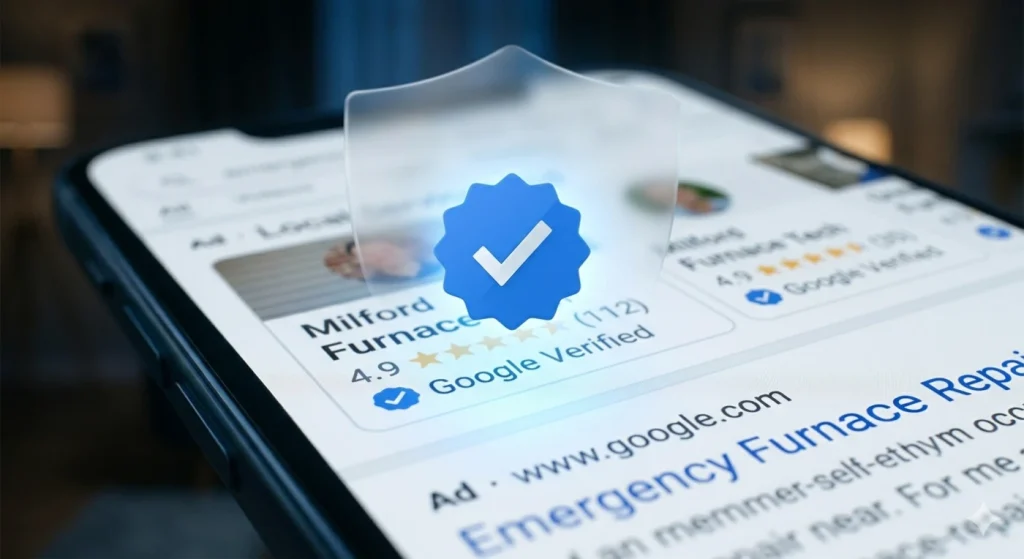
Google Local Services Ads: The Most Valuable Digital Real Estate for Local Businesses.
It’s 11 PM on a Thursday in January. The temperature outside is nine degrees. And your furnace just stopped working.
You grab your phone. You type “emergency furnace repair near me.” And you do what every single person in that situation does: you tap the first thing that looks trustworthy.
You don’t scroll. You don’t compare “About Us” pages. You don’t read reviews for twenty minutes. You call.
That first thing you tapped? It wasn’t a regular website. It wasn’t a traditional Google ad. It was a Google Local Services Ad, sitting at the very top of the screen with a photo, a star rating, and a blue “Google Verified” checkmark. And the business that showed up there just landed a paying customer while every competitor below the fold never got a second glance.
If you run a local service business, Google Local Services Ads represent the single most important shift happening in digital marketing right now. And if you’re not part of it, you’re invisible to the customers who need you the most.
How Google Local Services Ads Took Over the Top of the Page
Here’s something most business owners haven’t noticed yet: Google has been quietly rebuilding the entire first page of search results. And Google Local Services Ads are at the center of that rebuild.
Local Services Ads now sit above everything. Above regular Google Ads. Above the map listings. Above every single organic website result. On a mobile phone, which is where the vast majority of these searches happen, LSAs can fill the entire visible screen before a user even starts scrolling.
The expansion has been aggressive. According to SERP tracking data from BrightLocal and Semrush, the presence of localized ad packs on mobile search results jumped from under 3% of tracked queries to nearly 22% between November 2025 and January 2026. That’s not gradual growth. That’s a fundamental restructuring of how Google displays local businesses.
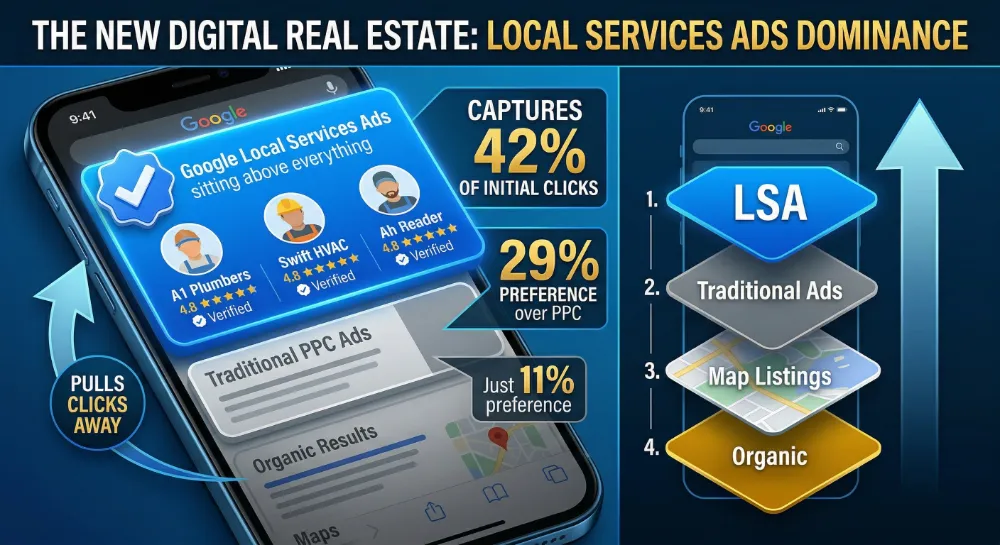
And users are responding exactly the way Google designed them to. In behavioral studies tracking where people click first on local service searches, the LSA block captured 42% of all initial clicks for competitive service categories. That’s nearly half of all attention going to the top three LSA results before anyone even sees a traditional ad or organic listing.
For home service businesses specifically, LSAs capture about 14% of all clicks just by occupying the most prominent visual position on the page. And 29% of searchers say they prefer LSA results over traditional pay-per-click ads, which sit at just 11% preference.
The math is simple. If your business isn’t in that top block, nearly half your potential customers never see you.
Why Google Local Services Ads Only Charge You When the Phone Rings
The pricing model behind Local Services Ads is what makes them genuinely different from everything else in digital advertising. And it solves a problem that has frustrated local business owners for years.
With traditional Google Ads, you pay every time someone clicks your link. Every. Single. Time. Accidental click? You pay. Visitor who leaves your website in three seconds? You pay. Competitor snooping on your prices? You pay for that too.
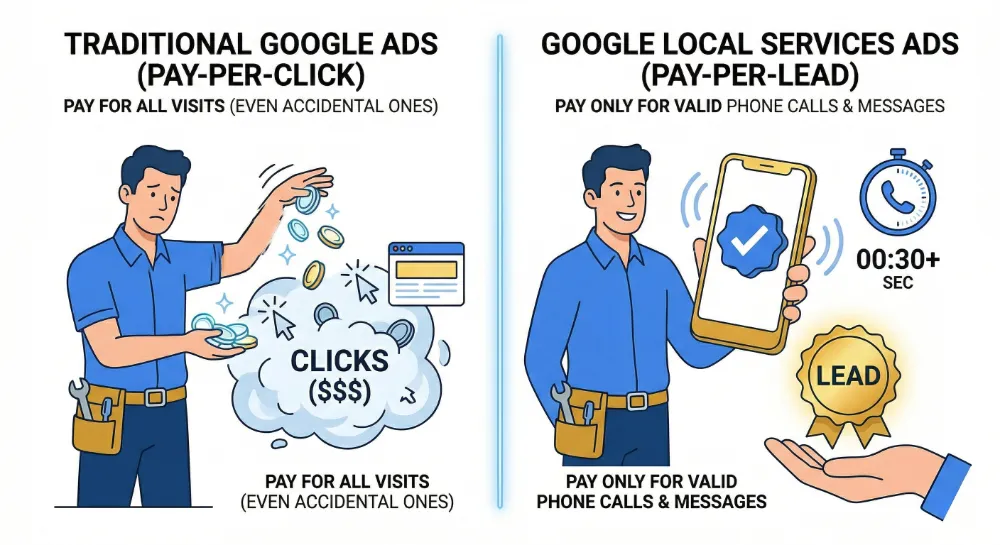
That pay-per-click model has a compounding problem. If your website converts visitors into actual phone calls at a rate of 10% (which is pretty typical for local service sites), you need to buy ten clicks just to generate one real lead. In competitive trades and metro markets, that adds up fast.
And industry-wide, the trend is moving in the wrong direction. Between 2024 and 2025, traditional cost per acquisition rose about 12% while conversion rates dropped by over 9%. Businesses are spending more and getting less. For home services specifically, conversion rates in ten out of sixteen subcategories decreased year-over-year heading into 2026, largely because map ads and LSAs are pulling clicks away from traditional text ads.
Local Services Ads flip the entire model. You don’t pay for clicks. You pay for leads. Specifically, you pay only when a prospective customer actually calls you (and the call lasts more than 30 seconds) or sends you a direct message requesting a quote. Google outlines the full pay-per-lead pricing structure on their LSA platform page. No more paying for accidental clicks, bounced visitors, or competitors snooping around.
The conversion difference tells the story. Traditional pay-per-click campaigns convert from click to customer at roughly 12%. LSA interactions convert at 31%. That gap exists because someone calling directly from a verified Google listing at the top of the search results is already committed. They need your service. They’re ready to book.
The cost per lead varies based on your trade, your market size, and how competitive your area is. But across the board, businesses using LSAs consistently report lower acquisition costs and higher lead quality compared to traditional search ads. The reason is structural: you’re only paying for people who actually picked up the phone and asked for help.
The Blue Checkmark: What “Google Verified” Actually Means
You’ve probably noticed blue verification checkmarks showing up across the internet. Google now has their own version, and for local service businesses, it’s the entry ticket to the top of the search results.
Until late 2025, Google ran two separate trust programs. “Google Guaranteed” covered home services with a green checkmark and included a consumer-facing money-back guarantee. “Google Screened” covered professional services like lawyers and financial advisors with credential verification but no financial backing.
In October 2025, Google merged both programs into a single “Google Verified” identity with a universal blue checkmark. The consumer guarantee was permanently discontinued in November 2025. Google’s verification and screening support documentation details the current requirements.
This wasn’t just a cosmetic change. Google shifted from trying to financially guarantee service quality (which created legal headaches and administrative friction) to strictly verifying that a business is legitimate. The consumer still sees an official trust signal. The business still gets premium placement. But the responsibility for delivering quality service sits entirely with the contractor.
Here’s why that matters strategically: in an era increasingly saturated with AI-generated content, fake reviews, and synthetic business profiles, Google recognized it needed a foundational “trust layer” across the web. The blue checkmark is that layer. It aligns with the same verification visual language used by Meta, X, and other major platforms, conditioning consumers to recognize a universal symbol of authenticity.
For the customer, the perception of safety remains fully intact. They see an official badge from Google and feel confident calling that business. For you, it means your review profile carries even more weight than before. The blue checkmark gets you into the game. Your star rating is what convinces someone to actually call. A verified business with a 3.8-star rating will lose to a verified competitor at 4.7 stars every time.
Getting Verified for Google Local Services Ads Isn’t Easy (And That’s the Point)
The barrier to entry for Local Services Ads is intentionally high. Google wants this to be hard. That’s what makes the trust badge valuable.
Unlike traditional Google Ads, which you can set up in an afternoon, the LSA verification process typically takes three to four weeks once you submit documents. Here’s what Google requires:
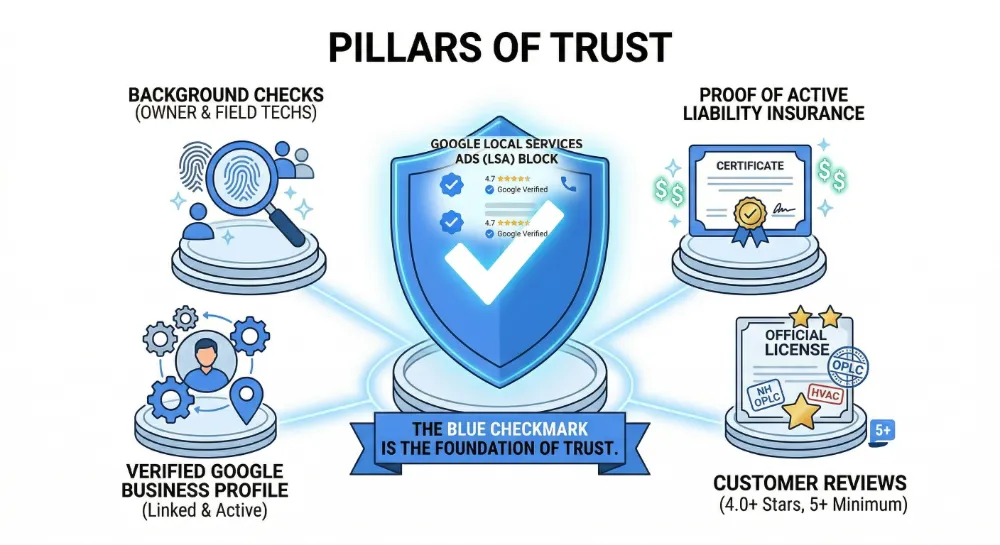
- Background checks for everyone. Google partners with third-party firms to run civil and criminal screening on all business owners. For trades where workers enter homes (HVAC, plumbing, electrical, garage door repair), every field technician and subcontractor must also pass. Administrative and office staff who don’t interact with customers in the field are generally exempt.
- Proof of insurance. Current certificates of insurance showing active general liability coverage that meets or exceeds Google’s thresholds for your trade. Specialized trades carry additional requirements: Garage Keepers Liability for auto repair shops, Cargo Liability and On-Hook insurance for tow operators.
- Active state and local licensing. Google cross-references your business against regulatory databases to confirm all licenses are current and match the services you’re advertising.
- A verified Google Business Profile. Since November 2024, an active and linked GBP is mandatory. Any suspension, incomplete data, or inconsistency pauses your LSA campaigns automatically.
- Customer reviews. A minimum baseline of reviews (typically at least five) with a rating of 4.0 stars or higher to maintain competitive visibility in the auction.
The Licensing Detail That Trips Up Most Businesses
The licensing requirement is where this gets especially granular, and where a lot of contractors get stuck.
Google’s system matches the exact job types you select in the LSA dashboard against the regulatory framework for your specific jurisdiction. In New Hampshire, this means verification through the Office of Professional Licensing and Certification (OPLC). An HVAC company needs specific classifications like Fuel Gas Fitter or Oil Heating Technician designations. A plumbing business needs Journeyman or Master Plumbing licenses on file.
If your license type doesn’t match the job category you’re advertising, the verification fails. A New Hampshire HVAC contractor who only has a plumbing license on file can’t run ads for furnace repair. The algorithm won’t allow it.
If any of these credentials lapse, your profile gets suspended and your leads stop immediately. No grace period. No warning email. Just silence. A license that expires on a Friday afternoon means zero leads over the weekend while your competitors absorb your call volume.
The Algorithm Behind Google Local Services Ads Is Watching How You Handle Every Lead
Here’s something most businesses don’t realize: Google’s AI is actively monitoring how you interact with the leads it sends you. And it uses that data to decide how many leads you get in the future.
When someone messages your business through an LSA listing and you take hours to respond, Google’s algorithm penalizes your future visibility. Every LSA call is routed through Google’s tracked proxy numbers, and AI analyzes the conversations. If you consistently fail to answer the phone, drop calls, or turn away business, the algorithm decides you’re a poor match for what customers need and shifts your lead volume to competitors who convert.
This goes both ways. Businesses that respond quickly, answer consistently, and convert a high percentage of leads get rewarded with better placement and more call volume. The system is designed to surface the businesses that actually serve customers well, not just the ones willing to spend the most.
The End of Manual Disputes
The lead quality system has also changed dramatically. The old system let businesses manually dispute bad leads (spam calls, wrong numbers, out-of-area inquiries) and request refunds from a human reviewer at Google. That system no longer exists. Google eliminated manual lead disputes in July 2024 and replaced the entire process with an automated, machine-learning-driven credit system.
Under the current system, leads are evaluated by Google’s algorithms at the moment of initial contact. Obvious spam and robocalls get filtered before they ever hit your account. For everything else, the AI reassesses charged leads over a 72-hour window using call transcription and sentiment analysis. If it determines a lead was poor quality, a credit gets applied automatically.
The critical change that catches unprepared businesses off guard: Google no longer issues credits for leads categorized as “job type not serviced” or “location not serviced.” If someone calls you for a service you don’t offer or from an area you don’t cover, Google considers that entirely your fault for configuring your profile incorrectly.
It’s also worth knowing that the automated credit system, while faster than the old manual process, is far from perfect. The AI doesn’t catch everything. Leads that a human reviewer would have clearly flagged as invalid sometimes slip through and get charged anyway. That’s not a reason to avoid the platform. It’s a reason to make sure your profile is configured with surgical precision from day one, so the bad leads don’t happen in the first place.
This makes precise profile management essential. Every zip code toggle, every job type selection, every service category needs to be accurate. One sloppy configuration means you’re paying for leads you can never convert, with no way to dispute them after the fact.
Training the Algorithm to Send You Better Leads
You still have one powerful lever to influence the system: the “Rate this lead” feedback tool inside the LSA dashboard.
After each interaction, you can rate the lead quality. To trigger a potential credit review, you need to select “Very dissatisfied” and choose a specific reason (spam, solicitation, wrong business, or duplicate). This feedback must be submitted within a 30-day window.
But the real value of this tool goes beyond individual refunds. Consistent, accurate rating of every single lead, both the great ones and the bad ones, trains Google’s algorithm to understand what your ideal customer looks like. Businesses that systematically evaluate all their leads report tangible improvements in overall lead quality within 60 to 90 days. The algorithm gets smarter about which calls to send your way and which to filter out. Skip the feedback, and you’re leaving the machine guessing.
Google Local Services Ads Don’t Replace Your Other Marketing. They Supercharge It.
Local Services Ads are the most effective tool for capturing high-urgency, ready-to-buy customers. But they work best as part of a broader strategy, not in isolation.
LSAs have real limitations. You can’t target specific keywords. Google’s algorithm decides entirely when and where your ad shows based on the broad job categories you’ve selected. You can’t run promotional copy, highlight seasonal discounts, or retarget people who visited your website.
And the biggest limitation is the budget ceiling. Once your weekly budget is exhausted, Google doesn’t throttle your ads or gradually reduce visibility. It shuts them off completely. One moment you’re at the top of the page, the next you’re gone. If a competitor has more budget headroom, they absorb every call you would have received until your next billing cycle resets. For contractors in high-demand seasons (think HVAC in January or plumbing in spring), that mid-week disappearing act can mean losing dozens of high-intent calls to the competition.
That’s where traditional Google Ads fill the gap. PPC allows for granular keyword targeting, demographic filters, and retargeting campaigns that re-engage visitors who didn’t convert the first time. Running both simultaneously means you capture the immediate emergency calls through LSAs while using PPC to target specific long-tail searches or maintain visibility when your LSA budget runs out.
Organic SEO feeds the system too. Since July 2025, Google exclusively uses your Google Business Profile reviews to calculate LSA rankings. A strong local SEO strategy drives review velocity on your GBP, which directly fuels your LSA performance. Your organic efforts are literally subsidizing your paid results. It creates a flywheel: better SEO drives more reviews, more reviews improve your LSA ranking, better LSA ranking generates more calls, and those completed jobs create more opportunities for reviews.
The Voice Search Connection
There’s also a future-proofing angle that most businesses haven’t considered yet. When someone says “OK Google, find an emergency plumber near me” through a smart speaker or AI assistant, the system can’t display a list of ten websites for the user to browse. It needs to recommend one trusted business, immediately.
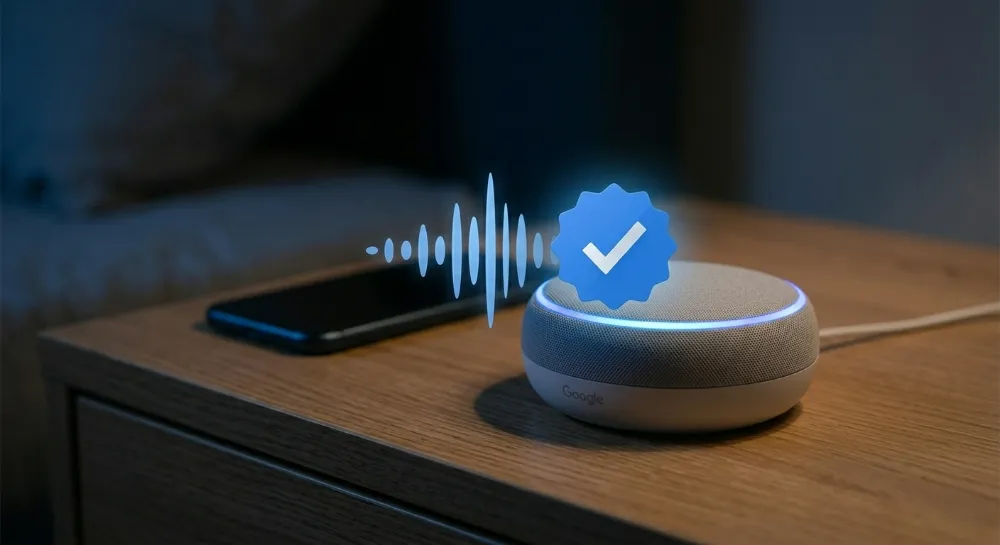
To avoid the risk (and liability) of directing a customer to a fraudulent or unqualified contractor, Google’s voice assistant prioritizes businesses that have cleared the full LSA background check, licensing verification, and insurance validation. Your LSA profile is essentially your ticket into voice-activated search. Without it, you don’t exist in that channel.
As smart speakers, AI assistants, and screenless search continue to grow, the businesses already verified through the LSA program will have a significant head start. Everyone else will be scrambling to catch up.
The Customers Are at the Top of the Page. Your Business Should Be Too.
Remember that homeowner at 11 PM with the broken furnace? They’re going to call someone in the next sixty seconds. The question is whether they’ll call you or the competitor whose verified profile is sitting at the top of their screen.
Google Local Services Ads have fundamentally changed how customers find and choose local service providers. The pay-per-lead model means you’re only paying for actual customer contact. The verification process builds instant trust with a badge consumers already recognize. The premium placement puts you ahead of every organic listing and traditional ad on the page.
But the complexity of the platform, from credential management to algorithmic feedback loops to precise geographic and service-type configuration, means this isn’t a set-it-and-forget-it channel. It requires active, informed management to perform at its best.
Want to find out if Local Services Ads are right for your business? Our team at Brandit helps local service businesses across New Hampshire and Southern Maine get verified, get visible, and start receiving qualified calls. No jargon, no pressure. Just a straightforward conversation about whether this makes sense for your situation. Reach out to us or call 603.645.2500.
- How Google Local Services Ads Took Over the Top of the Page
- Why Google Local Services Ads Only Charge You When the Phone Rings
- The Blue Checkmark: What "Google Verified" Actually Means
- Getting Verified for Google Local Services Ads Isn't Easy (And That's the Point)
- The Algorithm Behind Google Local Services Ads Is Watching How You Handle Every Lead
- Google Local Services Ads Don't Replace Your Other Marketing. They Supercharge It.
- The Customers Are at the Top of the Page. Your Business Should Be Too.
Ready to Take Your Brand Beyond Ordinary?
Your marketing shouldn’t just exist. It should perform. If you’re done settling for “good enough,” let’s build something impossible to ignore. Brandit helps you connect every digital, physical, and promotional touchpoint into one unstoppable brand experience.
Real Results,
Real Reactions
What Our Clients Say

"I sent out three bids for my marketing needs for this year and Brandit was the most responsive and provided great ideas. One company I reached out hadn't even gotten back to me while the other wasn't even close to being comparable to Brandit's creativity, pricing and service."
"I have used Brandit for several projects and they always come through with fantastic pricing and customer service. I highly recommend them."
Southern New Hampshire University

"Thanks to Brandit's generous contribution to the Big Ideas for Building Independence Capital Campaign, Easterseals NH is now better able to serve people with disabilities or special needs. With your support, we raised nearly $2.6 million for renovations to our headquarters."
"It has been an incredible journey! We couldn't have done it without you, and wish to take this opportunity to thank you and your team at Brandit Marketing Solutions for all that you have done and your generous donation."
Easterseals, NH

"Bringing Brandit Marketing Solutions into the CMC-fold is the best thing and most appreciative thing I've done since being at the Hospital."
Catholic Medical Center
"Exceptional does not even begin to cover the work that these people do. I have worked closely with other marketing firms and Brandit tops them every time. From innovative ideas to customer service that rivals the best of the best. I just couldn't speak more highly of them."
Southern New Hampshire University

"The Granite Group, headquartered in Concord, NH, distributes plumbing, heating, cooling, water and propane supplies to contractors and fuel dealers across New England through over 45 wholesale branches and their Online Store. The company also operates 15 retail showrooms under The Ultimate Bath Store name.
Brandit is pleased to say that we have been working with the Granite Group for over ten years which happens to be almost as long as this company has been in existence. In 2020, TGG was named one of New Hampshire's best places to work."
The Granite Group
10+ Year Partnership

"Over my long career, I have been in a position where I have worked closely with numerous vendors/suppliers. I can honestly say that I have never engaged with a company that is as amazing and responsive as Brandit."
"A sincere thanks to the team for the hustle on getting our shirts and tradeshow materials done for our group! You really relieved our pressure and I know it wasn't an easy task. Your effort and turnaround time was and is appreciated. Believe me when I say that I do not take for granted the relationship we have built over the years. Your service is top notch."
C&S Wholesale Grocers

"For almost a decade, the team at Brandit delivered successful and effective marketing solutions, spearheaded the merchandising of the FIRST brand by creating one-of-a-kind products, built, hosted, and managed their very first ecommerce store supporting all programs, staff, partners, sponsors, teams, and customers globally.
In addition, Brandit set up and managed multiple on-site retail stores at their premier Championship events where we serviced over 65,000 attendees. Today we provide web services as well as branded merchandise for regional partners".
FIRST Robotics

"The Brandit Marketing Solutions Ltd Team is wonderful to work with and we appreciate what they do to make us look good! They have expanded their services in recent years to meet whatever marketing needs you may have…from apparel and giveaway items to video and web services to graphic design and printing services, even graphic enhancements for your interior/exterior office space."
"I have worked with this team since the founding of their company and look forward to many more years of working together!"
Boys & Girls Club of Manchester

"The Brandit team is a talented group of creative professionals that I've worked with for years. Top notch!"
Art Murphy
Our Insights
.
Why Regional Trade Show Marketing Might Be Your Best Investment This Year
You just spent $25,000 on a booth at a massive industry expo. Three days, 40,000 attendees, and a fishbowl full of business cards. Back at the office, your team starts making calls. Most numbers go to voicemail. The ones who do pick up barely remember your booth. Sound familiar? Here’s a number that should change…
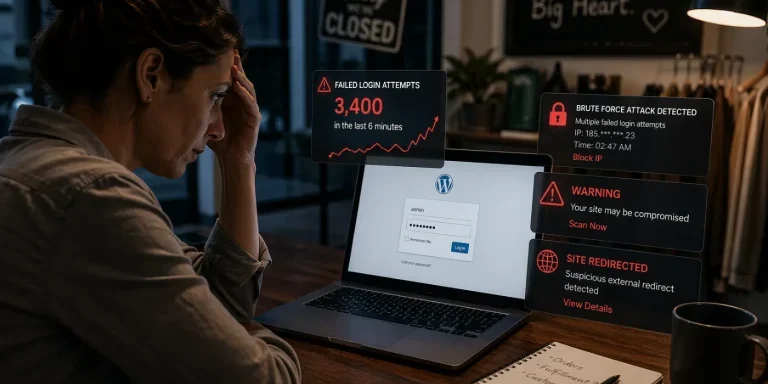
Website Security for Businesses: Your 2026 Survival Guide
Picture this. At 2:47 on a Tuesday morning, a retailer in Portsmouth has 3,400 login attempts hit the admin page of her WordPress site in under six minutes. By 2:53, one of them works. By sunrise, her homepage is redirecting customers to a fake pharmaceutical site, her Google rankings have collapsed, and her payment processor…

How to Build a Brand That Feels Human in an AI-Heavy Marketing World
There’s a beverage company you’d recognize by name. Last holiday season, their marketing team decided to rebuild their iconic TV ad using generative AI. New technology. Massive efficiency gains. Fraction of the production cost. The internet tore it apart. Viewers called it soulless. They weren’t wrong. The ad looked technically perfect in every sense, and…

Is Zero-Click Search Killing Your Website Traffic? Here’s the Real Answer
She refreshed the analytics dashboard one more time, hoping the numbers had changed. They hadn’t. Website sessions were down 31% year over year. The phone wasn’t ringing less. Leads were actually up. But her web traffic looked like it was falling off a cliff, and she couldn’t explain it to her business partner without sounding…

How to Turn Customer Wins Into B2B Success Stories That Actually Drive Sales
In B2B marketing, trust matters more than ever. Most buyers are not looking for another polished pitch. Instead, they want proof. They want to know your solution works, that companies like theirs have seen results, and that choosing you feels like a smart move. That is why customer success stories are so valuable. A strong…

Schema Markup: The Invisible Code That Gets Your Business Found on Google
You searched for a plumber at 9 PM on a Tuesday. Not just any plumber. One near you, with good reviews, open right now. Google handed you three options at the top of the page. Stars. Hours. Phone number. One click to call. You picked the first one. Here’s what you probably didn’t think about:…

Why Your Trade Show Booth Is a Ghost Town (And How to Fix It)
You spent $8,000 on the booth space. Another $3,000 on graphics. You shipped in a custom display, flew in two sales reps, and booked a hotel for three nights. Then the show doors opened, attendees streamed past your perfectly designed exhibit, and you spent most of Tuesday afternoon rearranging brochures. Sound familiar? It’s not a…
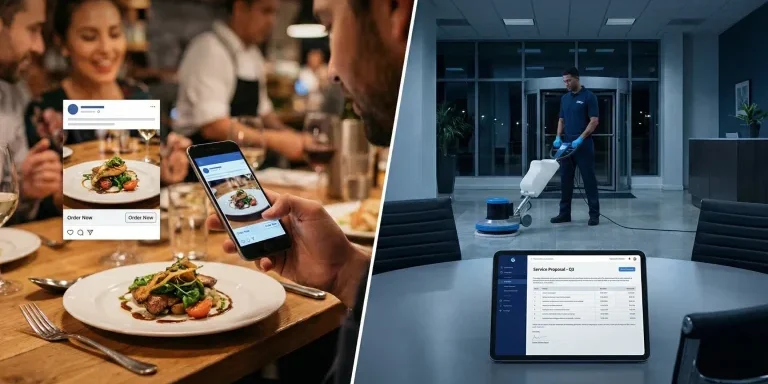
B2B vs B2C Marketing: What Local Brands Should Know in 2026
Two businesses. Same city. Same ad budget. Completely different results. A local restaurant owner runs Facebook ads featuring gorgeous food photography. Bookings spike within the week. Meanwhile, a commercial cleaning company runs nearly identical ads — same platform, same spend — and hears nothing. Not a single inquiry. Same tool. Same effort. Completely different outcome.…
Mobile-First Design: Guide, SEO Benefits & Best Practices (2026)
Your website loads on phones. But was it actually built for them? Most businesses still design for desktops first, then try to squeeze everything onto smaller screens. That approach is backward. Your customers aren’t browsing during lunch breaks at their desk anymore. They’re checking you out while standing in line, walking between meetings, or sitting…

WordPress vs Custom Development: Which Is Right for Your Business in 2026?
Which Platform Powers Your Business Goals in 2026? Your website is the foundation of your digital presence. It’s where customers find you, learn about your services, and decide whether to do business with you. So when it’s time to build or rebuild that foundation, one question keeps coming up: Should you use WordPress, or invest…
Omnichannel Marketing Solutions
Merging creativity and technology for comprehensive brand experiences.

PIXELS
Harnessing digital platforms for impactful brand promotion and audience engagement through strategic touchpoints.

PROMOS
Making the intangible tangible through high-quality promotional items that echo your brand's voice and values.

PLACES
Transforming physical environments into powerful brand narratives that forge connections with everyone who enters your space.