
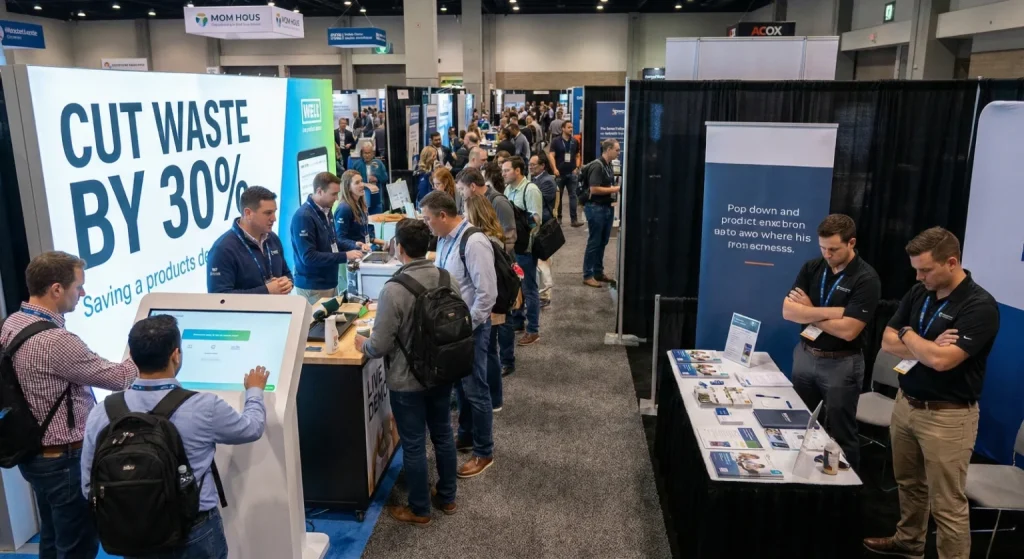
Why Your Trade Show Booth Is a Ghost Town (And How to Fix It)
You spent $8,000 on the booth space. Another $3,000 on graphics. You shipped in a custom display, flew in two sales reps, and booked a hotel for three nights. Then the show doors opened, attendees streamed past your perfectly designed exhibit, and you spent most of Tuesday afternoon rearranging brochures.
Sound familiar?
It’s not a fluke. It’s not a bad floor location. It’s a failure of strategy — and it happens to well-intentioned exhibitors at every trade show from Manchester to Las Vegas. The hard truth is that a beautiful booth without the right psychological architecture is exactly what researchers call a “subway to nowhere”: expensive, polished, and completely ignored.
The good news: this is entirely fixable. And once you understand what’s actually happening on that show floor, you’ll never exhibit the same way again.
Why Good Trade Show Booths Go Empty (And Fail to Attract Qualified Buyers)
Picture two booths at the same regional event. Same square footage. Similar budgets.
Booth A has a gorgeous 10-foot backlit display, a clean table with stacked brochures, and two reps standing with arms half-crossed, ready to engage anyone who makes eye contact. By 11 AM, it’s quiet.
Booth B has a small crowd gathered around something. More people slow down to look. By 11 AM, there’s a line.
What’s the difference? Not the quality of their display. Not their product. Booth B understood something fundamental about human behavior: people follow people.
The research backs this up in a way that should get every business owner’s attention:
- 81% of trade show attendees have direct purchasing authority
- 92% are actively looking for new products and solutions
- 90% haven’t had a face-to-face meeting with most exhibiting companies in the past year
- Attendees spend an average of 5.5 hours at an event
That’s a room full of qualified buyers, most of whom have never met you, with time to spend and a real reason to buy. And still, booth after booth sits quiet.
The problem is rarely the product. Most exhibitors treat the booth as a destination and wait for people to arrive. The exhibitors who clean up treat it as a gravitational field they actively engineer — starting with what the booth looks, feels, and even sounds like.
The Three Seconds That Decide Everything in Trade Show Booth Design
Here’s what no one tells you when you’re designing your display: attendees decide whether your booth is worth stopping at in about three seconds. Not three seconds to read your tagline. Three seconds of visual processing before their brain signals “relevant” or “skip.”
This is exactly why great booth branding is not a luxury — it’s the mechanism that puts you in the game at all.
For companies investing in custom environments, this often starts with strategic exhibit systems, backlit displays, and spatial hierarchy planning — not just graphics. (See how structured booth environments support visibility in our Display Solutions work.)
The approach that works treats your booth like three concentric circles, each one doing a specific job at a specific distance:

- 20+ feet out: The Hook One bold, high-contrast headline that speaks directly to the problem your prospect is trying to solve. Not your company name. Not a clever tagline. A problem-and-result statement in massive type — something like “NH Manufacturers: Cut Waste by 30%” hits harder at distance than your logo ever will. Industry standards recommend a minimum four-to-six inch font size for legibility at this range. That takes real design intention to pull off well.
- 10–15 feet: The Story As they move toward you, they need context. Who is this for? How does it work? This layer earns the final approach with one focused sentence that bridges the headline to the conversation.
- 3–5 feet: The Offer Now you can go deep — specs, demos, touchscreen prompts, QR codes, staff interaction. The prospect is already bought in. Now you close the loop.
Most booths try to say everything at once, everywhere, for everyone. The result is visual noise that reads as “not for me” before the brain even consciously processes it.
How Color Psychology Impacts Trade Show Booth Engagement and Brand Recall?
Before an attendee reads a single line of text, their brain has already processed your color palette. Strategic color choices can increase brand recognition by up to 80% — and in a crowded exhibition hall, color acts as your first, silent ambassador.
The 60-30-10 rule is the framework that keeps a booth visually grounded without becoming a kaleidoscope:
- 60% of your booth’s surface in your dominant brand color — the anchor
- 30% in a complementary secondary color — adds depth without chaos
- 10% in a high-contrast accent color — directs the eye to your most important focal points: lead capture stations, new product displays, primary screens
The specific colors you choose trigger specific psychological responses:
- Blue signals trust, stability, and professionalism. It lowers the pressure of the interaction, which is ideal for complex B2B conversations.
- Red creates urgency and stops the eye cold. It builds energy and attracts large crowds — but it needs to be balanced carefully.
- Green connects to growth, sustainability, and health. Critical for brands with an environmental story to tell.
- Orange and yellow project enthusiasm, accessibility, and innovation. They read as approachable and disruptive in traditionally conservative industries.
Pair those color choices with intentional lighting and the effect compounds. Bright white lighting reads as modern and precise. Warm amber lighting encourages people to slow down and linger in meeting spaces. Neither is better — it depends on the conversation you’re trying to have.
This is where working with experienced designers pays off. Getting the spatial hierarchy, typography scale, color ratios, and lighting to work together is genuinely difficult to pull off without professional execution.
Design decisions inside a booth don’t live in isolation. They’re part of a larger environmental branding strategy — the same principles used in physical space storytelling and experiential environments. (Explore how physical branding influences perception in our post on connecting emotional experiences to your brand in physical space.
How to Increase Trade Show Booth Engagement and Dwell Time?
Great branding gets people to look. What happens next determines whether they step onto your carpet.
Interactive elements are the bridge between “noticing” and “engaging.” They serve two purposes at once: they give attendees a low-pressure reason to stop that doesn’t require immediately talking to a salesperson, and they hold visitors in place long enough for the social proof effect to kick in.
Once you have four people gathered, passing traffic naturally slows to look. Once you have eight, your booth becomes a destination.
Interactive elements that earn their floor space include:
- Touchscreen kiosks with diagnostic questions — a three-to-four question survey gamifies the experience, captures lead data automatically, and feeds your CRM before your rep even says hello. When that data flows directly into structured follow-up systems, the booth stops being a moment and becomes part of a measurable pipeline. This is where integrated marketing systems matter.
- Live product demonstrations — movement draws eyes; a demo running on a loop or presented by staff creates a natural anchor
- Augmented reality or digital simulations — particularly effective for products that are difficult to physically transport or visualize
- Gamified experiences — digital wheels of fortune, trivia challenges, interactive product configurators
Don’t overlook the less visible sensory layers either. Sound shapes the atmosphere of your space in ways attendees feel without consciously registering. Upbeat background music generates energy. Quieter ambient tones create the acoustic privacy that makes serious conversations possible.
And scent — rarely used, massively underrated — connects directly to the brain’s memory and emotion centers. A crisp, clean fragrance implies precision and innovation. Warm vanilla or lavender creates comfort and draws people to linger. Major consumer brands like Starbucks and Apple have built entire spatial experiences around this principle. There’s no reason trade show exhibitors can’t borrow from the same playbook.
The Promotional Products Strategy That Outlasts the Trade Show
Here’s a number worth sitting with: 83% of consumers report being more likely to do business with a brand after receiving a promotional product. Among millennials, that climbs to 88%.
More remarkably, most people hold onto promotional items for one to five years. Even when they’re personally done with something, 80% pass it along to someone else. Your branded item keeps working long after the show floor goes dark.
But this only holds when the item is genuinely worth keeping. Intentional merchandise selection — aligned with brand positioning and buyer psychology — dramatically increases retention and recall. (Our deeper breakdown on strategic merchandise can be found in this Promotional Products Marketing Guide.)
The shift in 2025 and beyond is from volume to intention. The question isn’t “how many items can we hand out?” It’s “what item will this specific person actually use every single day?”
High-quality, strategically selected promotional products and apparel outperform generic giveaways because they solve real problems — and problem-solving builds brand memory.

Best Promotional Products for Trade Shows in 2025 (What’s Working Now)
- Functional technology sits at the top of the retention rankings because it solves real problems. A high-quality multi-cable charging kit or a solid power bank is something a busy professional reaches for constantly — and every time they do, your brand shows up at a moment of relief. A dying phone at a conference is a crisis. Being the brand that solved it is a memory.
- Premium apparel works when it genuinely rivals what people would buy for themselves. A well-constructed soft-shell jacket or quality embroidered pullover becomes a walking billboard in your prospect’s actual life. It gets worn in the office, at events, on weekends. A cheap branded t-shirt ends up in the back of a drawer.
- Wellness and self-care products have moved from novelty to expectation. Ergonomic desk accessories, quality hydration bottles with tracking features, essential oil kits — these items signal that your brand cares about the person, not just the transaction. That emotional distinction is harder to achieve with a digital ad.
- Eco-friendly and sustainable merchandise has crossed from differentiator to baseline. Products made from recycled materials, bamboo, organic cotton, or biodegradable components align your brand with the values your prospects already hold. In B2B contexts, especially with younger buyers, that alignment is a filter.
- Tech-integrated merchandise is the rising trend worth watching closely. Embedding QR codes or NFC tags into products or packaging bridges the physical gift to a digital experience — an exclusive content page, a product tutorial, a special registration link. For marketers, it transforms a branded item into a trackable engagement channel you can measure weeks after the show.
How Co-op Advertising Funds Reduce Trade Show Marketing Costs?
Premium merchandise requires real budget. But many businesses are sitting on untapped co-op advertising funds through manufacturer-sponsored programs tied to their purchase volume — and most don’t know it. Navigating those programs takes expertise, but the payoff can be thousands of dollars in premium, co-branded merchandise at a fraction of the direct cost. If you haven’t explored structured co-op advertising programs, you may be leaving real money on the table.
Post-Trade Show Lead Follow-Up Strategy That Drives Real ROI
Most of the ROI from a trade show isn’t captured on the show floor. It’s captured in the 30 days after. And most exhibitors completely squander it.
Roughly 80% of trade show leads go entirely un-followed. Not poorly followed up — completely ignored. The momentum and goodwill from that conversation dissipates rapidly as attendees return to overflowing inboxes and daily operations.
The window is short. A personalized first touchpoint within 24 to 48 hours is best practice. That’s when the context is still fresh, when they remember the conversation, when your brand is still active in their working memory. Structured email marketing workflows make sure this window doesn’t close by accident and help segment leads appropriately.
High-performing organizations build internal SLAs — same-day or next-business-day outreach requirements — so this window doesn’t close by accident.
How to Segment Trade Show Leads for Higher Conversion Rates?
Treating all trade show leads as a single group produces generic messaging that gets deleted. Segment ruthlessly based on what actually happened at the show:
- Hot leads requested a formal proposal, discussed pricing, or asked for a demo. They skip the nurture sequence entirely and go directly to a senior rep’s calendar within 24 hours, with a personal note referencing the specific conversation.
- Warm leads spent real time with you, engaged with your demo, or fit your ideal customer profile but aren’t ready to move yet. They need a thoughtful two-to-three week cadence of manual and automated touchpoints — not a blast, but a continuation of the conversation.
- Cold leads are badge scans from sweepstakes entries or passing traffic. They go into a long-term educational nurture that keeps your brand visible until a buying need surfaces.

How to Write a High-Converting Trade Show Follow-Up Email?
“Thanks for stopping by our booth” goes straight to deleted. A strong follow-up email has a few non-negotiable elements:
- A subject line that references the event and hints at something useful — not “Following up” but something like “Resources for the challenge you mentioned at BIA”
- A body that references the real conversation — the specific problem they brought up, the product they showed interest in. This is what signals to the reader that this is a human follow-up, not a blast
- Value before the ask — deliver the promised case study, whitepaper, or recorded tutorial before requesting anything in return
- One clear call to action — a calendar link, a download, a webinar registration. Multiple asks create decision paralysis
Beyond Email: Retargeting, LinkedIn Outreach & Multi-Channel Trade Show Marketing
Email is the foundation, but it’s one channel. Effective post-show follow-up runs on multiple tracks simultaneously:
The same audience you met at the show can be loaded into LinkedIn and Facebook as a custom audience, served with targeted ads, video testimonials, and content offers in the days after the event. Your brand maintains a consistent digital presence that reinforces what they experienced in person — physical at the show, digital at home. Strategic remarketing campaigns ensure your brand shows up when they begin researching solutions after the event.
Sales reps should also be sending LinkedIn connection requests with a personal note referencing the conversation. Moving the relationship into a professional social environment where ongoing content and engagement builds familiarity over time is how longer B2B sales cycles stay warm.
For high-value prospects, strategic gifting platforms have added a compelling new tool. Rather than shipping unsolicited items, these platforms let you send a gift offer the recipient actively accepts — and those emails see open rates above 83% with conversion-to-acceptance rates near 57%. The item itself (a quality branded product, a charitable donation option) triggers the psychology of reciprocity at the exact moment you’re asking for a meeting. The results speak for themselves: companies using this approach have reported 9x ROI on targeted campaigns.
Trade Show Marketing Strategy for New Hampshire Businesses
All of this applies whether you’re at a massive national trade show or at the Made In NH Expo at the DoubleTree in Manchester.
Regional events often produce better proportional ROI for local businesses precisely because the audience is more concentrated and the competition less overwhelming. A well-executed booth strategy at the BIA Annual Conference, the NH Municipal Association gathering, or the Granite Group Trade Show can generate more genuine pipeline than a passive presence at a national convention.
The infrastructure is here. Local vendors handle custom graphics, backlit displays, retractable banners, and pop-up systems that bring the visual hierarchy to life. Promotional product partners carry the premium merchandise needed to create lasting memory loops through strategic customer engagement programs. And a comprehensive digital follow-up strategy — Google Ads retargeting, LinkedIn campaigns, CRM-integrated email sequences — can be built and running before you ever load the truck.
The difference between the booth everyone visits and the booth no one remembers isn’t luck or budget size. It’s intention. It’s understanding that the event is the beginning of a relationship, not the whole thing — and that the real work, the work that converts a five-minute conversation into a client, happens in the strategy before the show and the follow-through after it.
Ready to walk into your next trade show with a strategy instead of just a display? Brandit helps New Hampshire businesses build integrated trade show programs that cover the full arc — booth presence, promotional merchandise, and post-show digital follow-up. Reach us at brandit.com or call 603.645.2500.
- Why Good Trade Show Booths Go Empty (And Fail to Attract Qualified Buyers)
- The Three Seconds That Decide Everything in Trade Show Booth Design
- How to Increase Trade Show Booth Engagement and Dwell Time?
- The Promotional Products Strategy That Outlasts the Trade Show
- Post-Trade Show Lead Follow-Up Strategy That Drives Real ROI
- Trade Show Marketing Strategy for New Hampshire Businesses
Ready to Take Your Brand Beyond Ordinary?
Your marketing shouldn’t just exist. It should perform. If you’re done settling for “good enough,” let’s build something impossible to ignore. Brandit helps you connect every digital, physical, and promotional touchpoint into one unstoppable brand experience.
Real Results,
Real Reactions
What Our Clients Say

"I sent out three bids for my marketing needs for this year and Brandit was the most responsive and provided great ideas. One company I reached out hadn't even gotten back to me while the other wasn't even close to being comparable to Brandit's creativity, pricing and service."
"I have used Brandit for several projects and they always come through with fantastic pricing and customer service. I highly recommend them."
Southern New Hampshire University

"Thanks to Brandit's generous contribution to the Big Ideas for Building Independence Capital Campaign, Easterseals NH is now better able to serve people with disabilities or special needs. With your support, we raised nearly $2.6 million for renovations to our headquarters."
"It has been an incredible journey! We couldn't have done it without you, and wish to take this opportunity to thank you and your team at Brandit Marketing Solutions for all that you have done and your generous donation."
Easterseals, NH

"Bringing Brandit Marketing Solutions into the CMC-fold is the best thing and most appreciative thing I've done since being at the Hospital."
Catholic Medical Center
"Exceptional does not even begin to cover the work that these people do. I have worked closely with other marketing firms and Brandit tops them every time. From innovative ideas to customer service that rivals the best of the best. I just couldn't speak more highly of them."
Southern New Hampshire University

"The Granite Group, headquartered in Concord, NH, distributes plumbing, heating, cooling, water and propane supplies to contractors and fuel dealers across New England through over 45 wholesale branches and their Online Store. The company also operates 15 retail showrooms under The Ultimate Bath Store name.
Brandit is pleased to say that we have been working with the Granite Group for over ten years which happens to be almost as long as this company has been in existence. In 2020, TGG was named one of New Hampshire's best places to work."
The Granite Group
10+ Year Partnership

"Over my long career, I have been in a position where I have worked closely with numerous vendors/suppliers. I can honestly say that I have never engaged with a company that is as amazing and responsive as Brandit."
"A sincere thanks to the team for the hustle on getting our shirts and tradeshow materials done for our group! You really relieved our pressure and I know it wasn't an easy task. Your effort and turnaround time was and is appreciated. Believe me when I say that I do not take for granted the relationship we have built over the years. Your service is top notch."
C&S Wholesale Grocers

"For almost a decade, the team at Brandit delivered successful and effective marketing solutions, spearheaded the merchandising of the FIRST brand by creating one-of-a-kind products, built, hosted, and managed their very first ecommerce store supporting all programs, staff, partners, sponsors, teams, and customers globally.
In addition, Brandit set up and managed multiple on-site retail stores at their premier Championship events where we serviced over 65,000 attendees. Today we provide web services as well as branded merchandise for regional partners".
FIRST Robotics

"The Brandit Marketing Solutions Ltd Team is wonderful to work with and we appreciate what they do to make us look good! They have expanded their services in recent years to meet whatever marketing needs you may have…from apparel and giveaway items to video and web services to graphic design and printing services, even graphic enhancements for your interior/exterior office space."
"I have worked with this team since the founding of their company and look forward to many more years of working together!"
Boys & Girls Club of Manchester

"The Brandit team is a talented group of creative professionals that I've worked with for years. Top notch!"
Art Murphy
Our Insights
.

Stale Service Pages Tell Google You’ve Closed. Here’s How to Tell It You Haven’t
Your phone used to ring. Then it slowed. Now your top service page sits on page two of Google, and you have no idea why. Nothing is broken. Your site loads. Your contact form works. Your services are the same ones you offered last year, and the year before that. So what changed? Probably nothing…
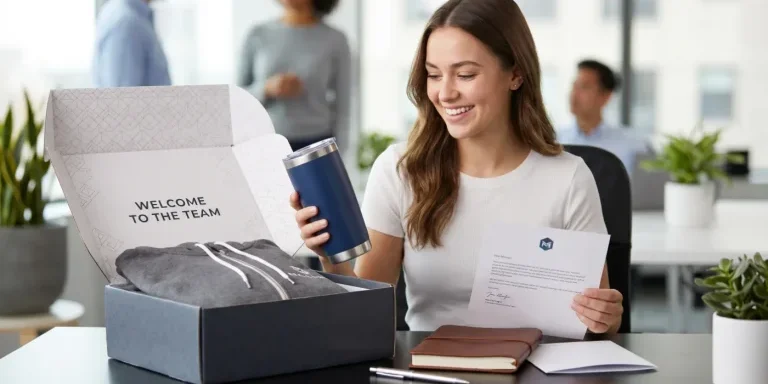
Your New Hire’s First Day Says a Lot About Your Company. The Welcome Kit Decides What.
Your new hire shows up on day one. Their laptop isn’t ready. Their manager is in back-to-back meetings. Someone hands them a stack of forms and a pen with another company’s logo on it. You just told them everything they need to know. The first day isn’t just paperwork. It’s the moment a new employee…
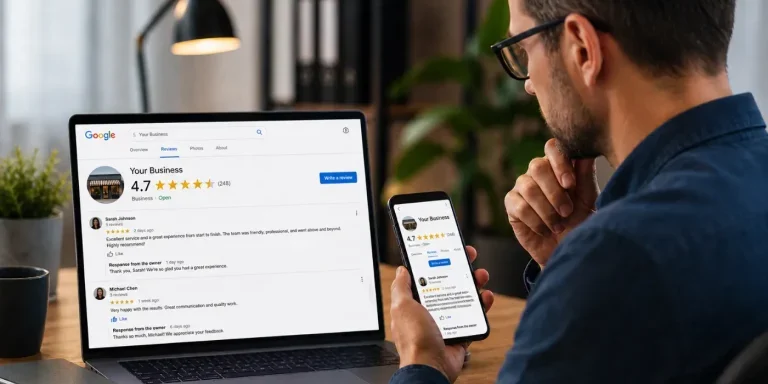
Your 4.7-Star Rating Is Quietly Losing You Customers
You opened your Google Business Profile this morning and saw a 4.7-star average across 34 reviews. Solid, right? Here’s the uncomfortable part. The most recent review is eight months old. None of them have owner responses. And down the street, a competitor sitting at 4.5 stars with 180 reviews, fresh feedback, and visible replies is…
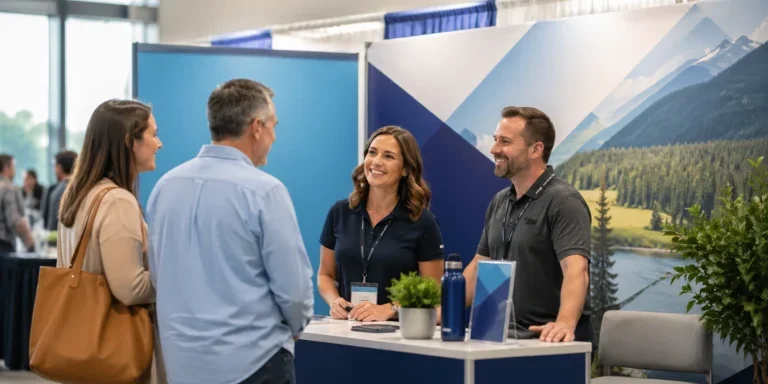
Regional Trade Show Marketing: Why Smaller Shows Can Deliver Bigger ROI
You just spent $25,000 on a booth at a massive industry expo. Three days, 40,000 attendees, and a fishbowl full of business cards. Back at the office, your team starts making calls. Most numbers go to voicemail. The ones who do pick up barely remember your booth. Sound familiar? Here’s a number that should change…
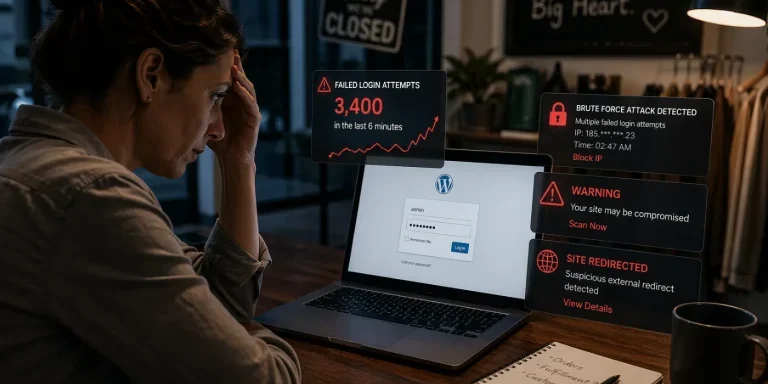
Website Security for Businesses: Your 2026 Survival Guide
Picture this. At 2:47 on a Tuesday morning, a retailer in Portsmouth has 3,400 login attempts hit the admin page of her WordPress site in under six minutes. By 2:53, one of them works. By sunrise, her homepage is redirecting customers to a fake pharmaceutical site, her Google rankings have collapsed, and her payment processor…
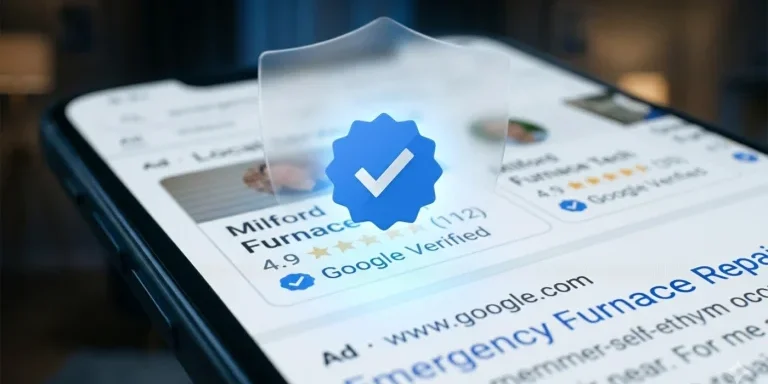
Google Local Services Ads: The Most Valuable Digital Real Estate for Local Businesses.
It’s 11 PM on a Thursday in January. The temperature outside is nine degrees. And your furnace just stopped working. You grab your phone. You type “emergency furnace repair near me.” And you do what every single person in that situation does: you tap the first thing that looks trustworthy. You don’t scroll. You don’t…

How to Build a Brand That Feels Human in an AI-Heavy Marketing World
There’s a beverage company you’d recognize by name. Last holiday season, their marketing team decided to rebuild their iconic TV ad using generative AI. New technology. Massive efficiency gains. Fraction of the production cost. The internet tore it apart. Viewers called it soulless. They weren’t wrong. The ad looked technically perfect in every sense, and…

Is Zero-Click Search Killing Your Website Traffic? Here’s the Real Answer
She refreshed the analytics dashboard one more time, hoping the numbers had changed. They hadn’t. Website sessions were down 31% year over year. The phone wasn’t ringing less. Leads were actually up. But her web traffic looked like it was falling off a cliff, and she couldn’t explain it to her business partner without sounding…

How to Turn Customer Wins Into B2B Success Stories That Actually Drive Sales
In B2B marketing, trust matters more than ever. Most buyers are not looking for another polished pitch. Instead, they want proof. They want to know your solution works, that companies like theirs have seen results, and that choosing you feels like a smart move. That is why customer success stories are so valuable. A strong…

Schema Markup: The Invisible Code That Gets Your Business Found on Google
You searched for a plumber at 9 PM on a Tuesday. Not just any plumber. One near you, with good reviews, open right now. Google handed you three options at the top of the page. Stars. Hours. Phone number. One click to call. You picked the first one. Here’s what you probably didn’t think about:…
Omnichannel Marketing Solutions
Merging creativity and technology for comprehensive brand experiences.

PIXELS
Harnessing digital platforms for impactful brand promotion and audience engagement through strategic touchpoints.

PROMOS
Making the intangible tangible through high-quality promotional items that echo your brand's voice and values.

PLACES
Transforming physical environments into powerful brand narratives that forge connections with everyone who enters your space.