

What Is AI Search Readiness and How Can Local Businesses Improve Visibility?
Your next lead may begin with an AI agent researching your company before a person ever visits your website or contacts your team.
Google is expanding the ways its AI-powered Search tools can help people find and compare local providers. A customer can describe what they need, ask Google to research nearby businesses, and use AI to gather details such as services, availability, and pricing. When important information is not available online, Google may even call local providers on the customer’s behalf.
The phone call may be the attention-grabbing part, but the larger issue is what AI can learn before contact. It can evaluate information across your website, Google Business Profile, reviews, directories, social profiles, and other online sources.
That means AI search readiness is really a digital presence issue. Your business needs to publish enough clear, specific, consistent, and trustworthy information for both people and AI systems to understand what you do, where you do it, who you serve, and why you deserve consideration.
Quick answer: AI search readiness for a local business means making your services, locations, proof, pricing context, availability, reviews, business listings, and technical website signals easy for search systems to identify, verify, cite, and pass to a customer action.
How AI Search Is Changing Local SEO and Customer Research?
Google’s AI Mode can help users research service costs, compare options, check local availability, and complete multi-step tasks. Instead of opening a long list of search results and evaluating each business manually, a customer may ask one detailed question and let AI perform much of the early research.
Imagine a New Hampshire homeowner looking for an electrician who works on older homes, serves the Concord area, and can evaluate a frequently tripping electrical panel. The homeowner is not simply searching “electrician near me.” The request contains a service, a property type, a location, a problem, and a desired next step.
An AI search experience may break that request into related searches, compare sources, and assemble a shorter list of providers. Google calls this “query fan-out.” and its own Search Central guidance explains that AI Overviews and AI Mode may issue multiple related searches across subtopics and data sources to develop a response.
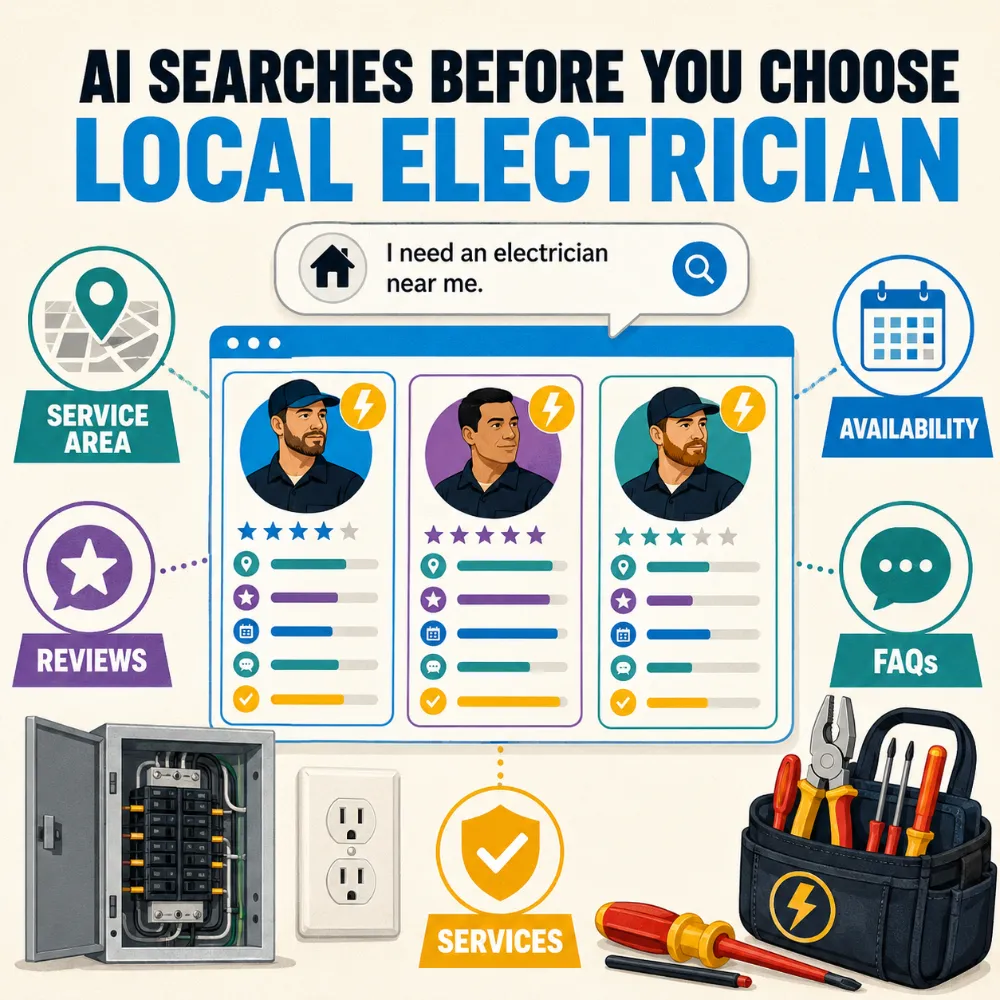
If your company’s digital presence only says “quality electrical solutions,” the system has very little useful information to connect with that request. If your website clearly explains panel inspections, older-home electrical work, service areas, credentials, common warning signs, and the scheduling process, it has far more context to work with.
The customer remains the decision-maker. However, AI may increasingly influence which companies reach the customer’s consideration set. Your digital presence needs to answer the first round of questions before your team ever has the opportunity to speak for the business.
AI Overviews, AI Mode, Maps, and AI Assistants Are Not the Same Thing
It helps to separate the surfaces. AI search is not one doorway. A local customer may see a Google AI Overview, continue in AI Mode, compare the local pack, open Maps, ask a voice assistant, or use a third-party AI tool. The fundamentals overlap, but each experience may rely on a slightly different mix of website content, local business data, reviews, source citations, and customer intent.
| Experience | Typical User Behavior | Local-Business Opportunity |
|---|---|---|
| Google AI Overviews | Researches a question before choosing a provider | Earn citations from useful service, cost, process, and problem-solving content |
| Google AI Mode | Asks longer questions, compares options, and continues with follow-ups | Provide detailed, verifiable facts across the site and Business Profile |
| Google Maps and local pack | Looks for nearby providers, directions, reviews, hours, or calls | Optimize categories, services, reviews, photos, hours, and local relevance |
| Third-party AI assistants | Requests recommendations or comparisons in conversational form | Maintain accurate web-wide business information and strong third-party evidence |
Google’s guidance for AI features and your website makes one point especially clear: there is no separate AI-only index to chase. Strong, accessible, useful web content still matters because generative Search features rely on Google’s broader Search systems.
How Does Google’s AI Calling Work for Local Businesses?
Google says automated calls may be used to help customers with tasks such as booking appointments, checking product or service pricing and availability, and confirming business details. These calls are part of the customer-research process, not a replacement for a human sales conversation.
If your team receives an AI-mediated call, the best response is plain and structured: confirm the requested service, state the service area, provide a realistic price range or cost factors when possible, explain what affects the final quote, confirm current availability, and give the customer a clear next step.
A contractor, for example, does not need to quote a final panel-replacement price over the phone without seeing the home. But the team can explain whether the service is offered, which towns are covered, whether estimates are free or paid, what information is needed, and how soon an inspection can be scheduled.
Verified businesses can manage automated-call settings through their Google Business Profile. Google’s Business Profile help page on automated calls from Google on behalf of customers explains how businesses can turn bookings and inquiry calls on or off. Opting out may be reasonable for some companies, but it can also remove one possible customer-research channel.
What Does AI Need to Understand About Your Business?
An AI system does not experience your brand exactly the way a person does. It gathers usable facts and supporting context from information that search engines can access and interpret.
At a minimum, your digital presence should make the following clear:
- Which specific services, products, or solutions you provide
- Where you are located and which communities or regions you serve
- Who each service is intended for and what problems it addresses
- What qualifications, specialties, capabilities, or limitations apply
- How estimates, scheduling, availability, and pricing generally work
- Which business category, service area, credentials, and team expertise support the claim
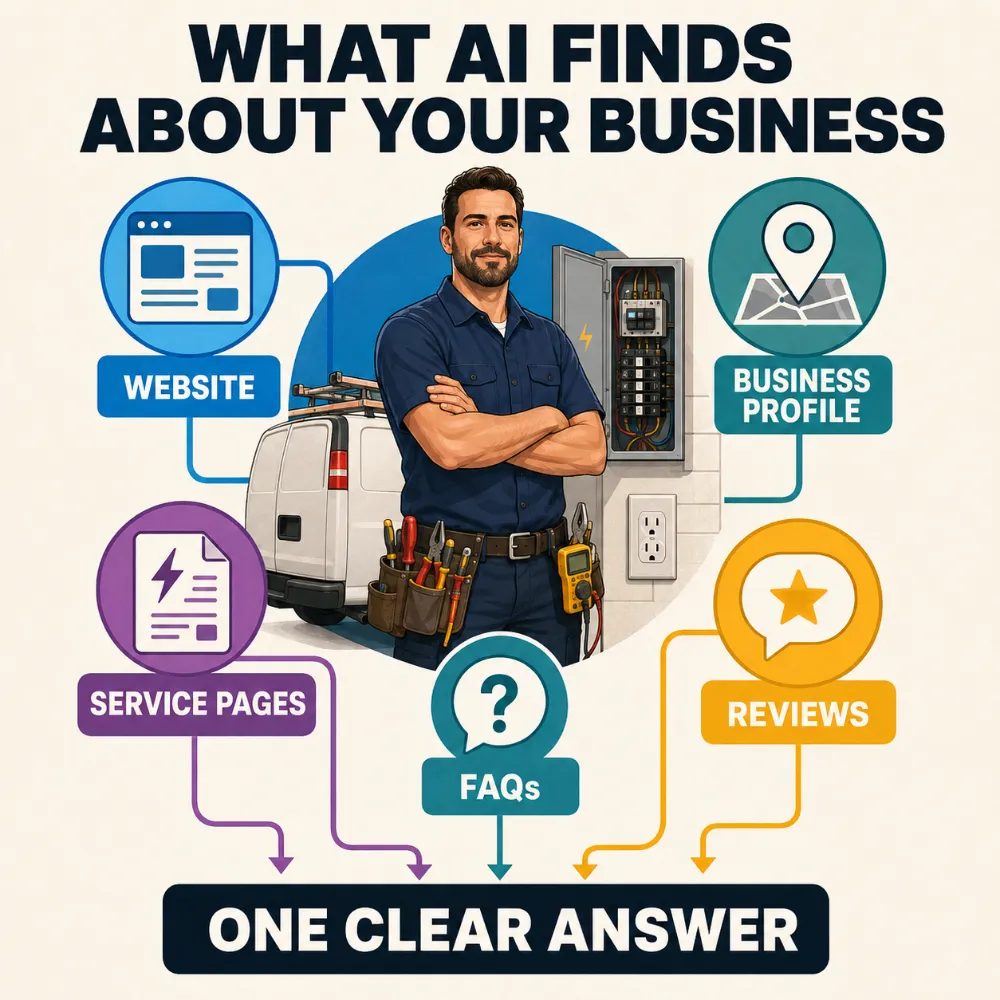
You do not need to publish a fixed price for every service. Many contractors, manufacturers, and professional service providers cannot quote accurately without learning more about the project. You can still explain whether consultations are free or paid, what factors influence cost, what information is required for an estimate, and what a customer should expect next.
This is not about feeding AI a special script. It is about helping customers, search engines, and AI systems reach the same accurate understanding of your company. If your website foundation is thin, Brandit’s article on website development in digital marketing success is a useful place to start.
Why Vague Websites Create Problems in AI Search?
Many local business websites rely heavily on phrases such as “quality service for every need,” “solutions you can trust,” or “your local experts.” Those statements may sound positive, but they provide almost no information about the actual service, location, customer, process, or expertise.
Compare that language with a page titled “Commercial Fire Alarm Inspections in Manchester, NH.” A focused page can explain which facilities the company serves, what the inspection includes, how often testing may be required, which surrounding communities are covered, what credentials the team holds, and how to request service.
That does not guarantee selection by an AI system, and Google has not announced a special formula that rewards pages written for automated agents. In fact, Google’s guidance for generative AI search says that established SEO fundamentals still apply. Google recommends useful, original, people-first content and a clear technical structure instead of AI-specific tricks.
Strong service pages should answer the questions a qualified prospect is likely to ask. What do you provide? Who is it for? Where is it available? What problems can you solve? What happens next? What makes your company credible?
These have always been good website and local SEO practices. AI-assisted search raises the cost of leaving them unanswered. For a local SEO foundation, Brandit’s guide to local versus traditional SEO explains why proximity, relevance, prominence, and local proof matter alongside broader organic visibility.
What Content Helps a Local Business Appear in AI Search?
Query fan-out changes the content challenge. A single customer question can contain a service, a location, a cost concern, a comparison, a symptom, and a next step. Your content architecture should make those pieces easy to find without creating thin pages for every tiny keyword variation.
Useful page types include service pages, legitimate service-and-location pages, cost and pricing guides, problem or symptom guides, process pages, comparison pages, case studies, and FAQs drawn from real sales conversations. The goal is not to publish more words for AI. The goal is to answer the research-stage questions a real customer asks before they are ready to call.
A heating company might explain “heat pump installation in older New Hampshire homes,” “heat pump versus oil heat,” “what affects installation cost,” and “what happens during an in-home assessment.” Those pages build topical authority because they connect services, locations, problems, process, and expertise.
How to Build a Consistent Digital Presence Across Your Website, GBP, and Listings?
Your website is the center of your digital presence, but it is not the only source an AI-powered search experience may encounter. Search engines can compare information from business listings, customer reviews, social profiles, professional associations, local news, videos, directories, and other websites.
Every source does not need to contain identical copy. It should, however, tell the same basic story. Your company name, location, service area, contact information, capabilities, and business category should not change depending on where someone looks.
This is especially important for companies that have evolved. A contractor may have added electrical work but still be described as plumbing-only in old directories. A manufacturer may serve new industries while its website remains focused on one legacy market.
AI did not create those gaps. It makes them easier to expose by gathering and comparing more sources.
Think of your digital presence as a body of evidence. Your website explains the business. Your Google Business Profile confirms local facts. Reviews, case studies, photos, credentials, and community mentions support your claims.
NAP consistency confirms identity. Service, category, location, and expertise consistency confirm meaning. That is the deeper entity-recognition issue local businesses need to solve.
Your Google Business Profile Is Part of the Answer
For a local company, the Google Business Profile is one of the most visible sources of business information across Google Search and Maps. Google’s current generative AI guidance specifically recommends maintaining local business details so products and services can be eligible to appear in AI responses and other search experiences.
Review your categories, services, hours, website link, service area, business description, and booking options. Add current photos and update special hours when schedules change.
Then compare the profile with your website and other important listings. If your website says you serve Southern New Hampshire, one directory says all of New England, and another lists an address you left three years ago, the overall picture is less dependable. Brandit’s Google Business Profile optimization guide covers that cleanup process in more detail.
Technical details can reinforce that clarity. Google explains that LocalBusiness structured data can identify details such as a business name, address, phone number, hours, URL, and location. Structured data is not a shortcut to visibility, and Google says there is no special schema required for generative AI search. Properly implemented markup is still a sound SEO practice because it helps search engines interpret important business facts.
For local businesses, schema can also clarify service relationships when it is implemented carefully. LocalBusiness schema identifies the entity. Service schema can help describe what the business provides, who provides it, and where it is offered. Brandit’s guide to schema markup for local business explains how this works without treating schema as a magic ranking lever.
Reviews and Real-World Proof Strengthen the Picture
A company can describe itself as responsive, professional, experienced, and locally trusted. Reviews and other third-party signals show whether customers and community sources consistently describe it the same way.
Recent, authentic reviews can add context about your work, service area, and customer experience. Case studies, team biographies, project galleries, certifications, awards, and credible local coverage provide additional proof.
Do not script customer reviews, pressure people to include target keywords, or chase manufactured mentions simply to influence AI. Ask for honest feedback after completed work, make the process simple, and respond professionally. The goal is to build a trustworthy public record that supports the promises your brand makes elsewhere.
Reviews help with more than star ratings. Review recency, response quality, service-specific language, and issue resolution can all support the broader reputation picture. Brandit’s Google review management and local SEO guide explains how to build that record without drifting into spammy review tactics.
How Third-Party Sources Validate a Local Business
Some evidence lives outside your own website. Structured citations, such as directory listings and chamber profiles, help confirm business facts. Unstructured citations, such as local news mentions, professional association pages, sponsorship pages, customer discussions, manufacturer directories, and expert interviews, can corroborate what your brand is known for.
This does not mean buying random mentions or planting fake forum conversations. It means earning legitimate local and industry proof: projects, partnerships, certifications, community work, media coverage, and customer stories that accurately reflect the business.
Video can also strengthen that proof layer when it shows real people, real work, and real outcomes. Brandit’s article on video testimonials is relevant here because first-party stories often explain trust better than another generic service paragraph.
Do FAQs Help With AI Search?
Yes, a useful FAQ section can strengthen a service page, but not because it unlocks a secret AI-search advantage.
Frequently asked questions create a natural place to address specific details that may not fit smoothly into the main page. A heating contractor can explain whether a heat pump works with an existing oil system. A security company can clarify whether customers own the installed equipment. A manufacturer can state which certifications, materials, tolerances, or production volumes it supports.
Those answers help customers evaluate fit and give search systems clearer context. The best questions come from sales conversations, service calls, Search Console data, and customer objections, not keyword variations created only to make a page longer.
It is also important to separate FAQ content from FAQ structured data. Google has limited FAQ rich results primarily to well-known, authoritative government and health websites. For a typical local business, adding FAQPage schema is unlikely to produce the expandable FAQ display that was once common in search results.
That does not make the content unimportant. A well-written FAQ is valuable because it answers a real question clearly, improves the usefulness of the page, and may reinforce the subject matter around a service. Publish FAQs for customers first. Treat any search benefit as a result of better content, not as a schema trick.
Five-Point AI Search Readiness Audit for Local Businesses
You do not need to predict every way AI search will evolve. Start by testing whether your business is easy to find, understand, verify, and choose today.

- Search for your priority services. Use detailed service-and-location searches, not just your company name. Review what appears across your website, map listing, directories, reviews, images, and third-party sources.
- Audit your highest-value pages. Confirm that each priority service page clearly explains the service, audience, location, expertise, common questions, supporting proof, and next step.
- Compare your business facts. Check that your name, location, hours, service area, website, categories, and core capabilities agree across the sources customers are most likely to encounter.
- Strengthen missing answers. Use real customer questions to improve service copy, FAQs, case studies, team biographies, project examples, and other content that demonstrates experience.
- Check technical discoverability. Make sure priority pages are crawlable, indexable, mobile-friendly, internally linked, and represented accurately in your sitemap, structured data, and Google Search Console.
Google’s official guidance makes an important point: businesses do not need to rewrite everything for AI, create an llms.txt file for Google, break every page into tiny content chunks, or adopt a new type of AI markup. The more durable opportunity is to improve the same fundamentals that already make a website useful and visible.
If a customer, search engine, AI assistant, and directory would each reach a different conclusion about what your company does, the issue is not an AI problem. It is a digital clarity problem.
How Do You Measure AI Search Visibility?
AI visibility needs measurement, not guesswork. Google introduced dedicated Search Console reporting for generative AI features, including AI Overviews and AI Mode, so site owners can review how pages appear in those surfaces. That should sit alongside traditional organic clicks, local pack visibility, Google Business Profile calls, direction requests, form completions, and quote requests.
For AI-answer visibility outside standard analytics, maintain a controlled prompt set. Test service-and-location queries, cost questions, comparison questions, problem-solving questions, and brand-specific questions. Record whether the business is mentioned, cited, described accurately, associated with the right services, and connected to the correct locations.
Also keep an accuracy log. Wrong hours, outdated addresses, discontinued services, incorrect price assumptions, or confusion with similarly named companies should be traced back to the source and corrected. Brandit’s guide to local SEO tools can help teams think through monitoring, audits, and visibility checks.
What Should You Do If AI Gets Your Business Information Wrong?
First, identify the exact incorrect statement. Then find the source likely supporting that statement: an old website page, an outdated Google Business Profile field, a forgotten directory, a review snippet, a social profile, or a third-party article.
Correct the source you control first. Update the website, GBP, schema, service pages, hours, pricing language, or location information. Then request corrections from publishers that control inaccurate profiles or mentions. Recheck the same prompt over time and document whether the answer changes.
This is slow work, but it is the right work. AI hallucinations and outdated local information are usually symptoms of a messy digital footprint, not something a single plugin can repair.
AI Readiness Is Really Brand Readiness
The arrival of AI agents does not erase traditional marketing. It exposes the gaps between its parts.
Your digital presence needs clear service content, sound local SEO, accurate listings, useful FAQs, credible proof, and a reliable technical foundation. Your visual identity, signage, vehicles, promotional materials, and customer experience should reinforce the same company people discover online.
Businesses that connect those pieces will be better prepared whether discovery begins with a traditional search, an AI-generated answer, a map result, a voice assistant, or an automated agent.
Brandit helps New England businesses build a connected brand ecosystem across PIXELS, PROMOS, and PLACES. If your digital presence no longer reflects the full strength of your business, we can help identify the gaps, clarify the message, and make your company easier to find, understand, trust, and choose.
If you want a practical review of your website, local SEO, Google Business Profile, structured data, and customer-proof signals, Brandit’s SEO team and web development team can help turn AI readiness into a cleaner digital presence.
- How AI Search Is Changing Local SEO and Customer Research?
- AI Overviews, AI Mode, Maps, and AI Assistants Are Not the Same Thing
- How Does Google’s AI Calling Work for Local Businesses?
- What Does AI Need to Understand About Your Business?
- Why Vague Websites Create Problems in AI Search?
- What Content Helps a Local Business Appear in AI Search?
- How to Build a Consistent Digital Presence Across Your Website, GBP, and Listings?
- Your Google Business Profile Is Part of the Answer
- Reviews and Real-World Proof Strengthen the Picture
- How Third-Party Sources Validate a Local Business
- Do FAQs Help With AI Search?
- Five-Point AI Search Readiness Audit for Local Businesses
- How Do You Measure AI Search Visibility?
- What Should You Do If AI Gets Your Business Information Wrong?
- AI Readiness Is Really Brand Readiness
Ready to Take Your Brand Beyond Ordinary?
Your marketing shouldn’t just exist. It should perform. If you’re done settling for “good enough,” let’s build something impossible to ignore. Brandit helps you connect every digital, physical, and promotional touchpoint into one unstoppable brand experience.
Real Results,
Real Reactions
What Our Clients Say

"I sent out three bids for my marketing needs for this year and Brandit was the most responsive and provided great ideas. One company I reached out hadn't even gotten back to me while the other wasn't even close to being comparable to Brandit's creativity, pricing and service."
"I have used Brandit for several projects and they always come through with fantastic pricing and customer service. I highly recommend them."
Southern New Hampshire University

"Thanks to Brandit's generous contribution to the Big Ideas for Building Independence Capital Campaign, Easterseals NH is now better able to serve people with disabilities or special needs. With your support, we raised nearly $2.6 million for renovations to our headquarters."
"It has been an incredible journey! We couldn't have done it without you, and wish to take this opportunity to thank you and your team at Brandit Marketing Solutions for all that you have done and your generous donation."
Easterseals, NH

"Bringing Brandit Marketing Solutions into the CMC-fold is the best thing and most appreciative thing I've done since being at the Hospital."
Catholic Medical Center
"Exceptional does not even begin to cover the work that these people do. I have worked closely with other marketing firms and Brandit tops them every time. From innovative ideas to customer service that rivals the best of the best. I just couldn't speak more highly of them."
Southern New Hampshire University

"The Granite Group, headquartered in Concord, NH, distributes plumbing, heating, cooling, water and propane supplies to contractors and fuel dealers across New England through over 45 wholesale branches and their Online Store. The company also operates 15 retail showrooms under The Ultimate Bath Store name.
Brandit is pleased to say that we have been working with the Granite Group for over ten years which happens to be almost as long as this company has been in existence. In 2020, TGG was named one of New Hampshire's best places to work."
The Granite Group
10+ Year Partnership

"Over my long career, I have been in a position where I have worked closely with numerous vendors/suppliers. I can honestly say that I have never engaged with a company that is as amazing and responsive as Brandit."
"A sincere thanks to the team for the hustle on getting our shirts and tradeshow materials done for our group! You really relieved our pressure and I know it wasn't an easy task. Your effort and turnaround time was and is appreciated. Believe me when I say that I do not take for granted the relationship we have built over the years. Your service is top notch."
C&S Wholesale Grocers
"For almost a decade, the team at Brandit delivered successful and effective marketing solutions, spearheaded the merchandising of the FIRST brand by creating one-of-a-kind products, built, hosted, and managed their very first ecommerce store supporting all programs, staff, partners, sponsors, teams, and customers globally.
In addition, Brandit set up and managed multiple on-site retail stores at their premier Championship events where we serviced over 65,000 attendees. Today we provide web services as well as branded merchandise for regional partners".
FIRST Robotics

"The Brandit Marketing Solutions Ltd Team is wonderful to work with and we appreciate what they do to make us look good! They have expanded their services in recent years to meet whatever marketing needs you may have…from apparel and giveaway items to video and web services to graphic design and printing services, even graphic enhancements for your interior/exterior office space."
"I have worked with this team since the founding of their company and look forward to many more years of working together!"
Boys & Girls Club of Manchester

"The Brandit team is a talented group of creative professionals that I've worked with for years. Top notch!"
Art Murphy
Our Insights
.
Brand Consistency: Make Your Site & Sign Match
Your website looks sharp. Your storefront sign looks fine. Your business cards came back a slightly different shade of blue than you remembered. Each one on its own seems like a small thing. Together, they cost you customers and money. Brand consistency is whether everything a customer sees from you looks and sounds like it…

Sustainable Promotional Products: A Buyer’s Reality Check
That recycled tote you ordered for the trade show has a problem. The product page called it eco-friendly, you felt good about the choice, and you moved on. Here is the uncomfortable part: when auditors actually test merchandise carrying self-declared green labels, close to half cannot back up the claim. The word on the page…
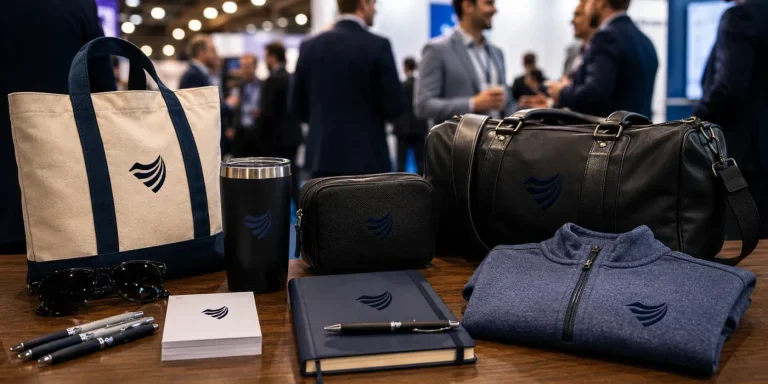
Premium vs. Volume: Rethinking Your Promotional Products Budget
You order 500 pens for the trade show. They cost a little over a dollar each, they have your logo, and they feel like a responsible use of the budget. Three weeks later, most of them are in a junk drawer, a parking lot, or a trash can. A few never made it out of…

Holiday SEO Timeline: Why December Rankings Start in Summer
The businesses that dominate search results this December made their move back in July. Not out of habit. They moved early because search rewards steady, consistent work in a way that no last-minute push can replicate. Holiday SEO is not a campaign you switch on when the decorations come out. It is an advantage you…

Corporate Holiday Gifting Timeline: Why Q4 Planning Starts in July
Here is the part nobody tells you about corporate gifting: the best time to lock in your holiday program is right now, in July. Not October. Not “right after Halloween.” July. That sounds early enough to be a joke. It is not. The companies that run corporate gifting well, sending memorable and on-time gifts to…

Website Performance Audit: Why Q3 Beats Q4 Every Time
Your website traffic is about to drop. Vacations start, inboxes go quiet, and the steady hum of summer browsing replaces the urgency of buying season. Most businesses read that slowdown as a reason to coast. That is the expensive mistake. The quiet stretch from July through September is the best window all year to run…

Summer Foot Traffic: Win It With a Mobile-First Website
Picture a family on a sidewalk in Portsmouth on a Saturday in July. It is 86 degrees, the kids are hungry, and someone pulls out a phone and types “lunch near me.” Three places show up on the map. They tap the first one. If that site loads fast and the menu is right there,…

Modern Phishing Scams: What Smart Businesses Need to Know
The old advice for spotting a scam email no longer works. Watch for bad spelling, awkward grammar, and a generic greeting, and you were safe. That rule protected people for years. Modern phishing scams have erased every one of those tells. Attackers now write clean, personalized messages, hide their links inside images, and move the…

Branded Koozies and Sunglasses Aren’t Lazy: High-Yield Summer Promotional Products
Someone on your team just rolled their eyes at the idea of branded sunglasses. Too obvious. Too expected. Let’s do something clever instead, maybe a little desk gadget or a puzzle nobody asked for. That instinct feels smart. It usually costs you the campaign. Here’s the part most people miss: the “clever” item lives on…

Stale Service Pages Tell Google You’ve Closed. Here’s How to Tell It You Haven’t
Your phone used to ring. Then it slowed. Now your top service page sits on page two of Google, and you have no idea why. Nothing is broken. Your site loads. Your contact form works. Your services are the same ones you offered last year, and the year before that. So what changed? Probably nothing…
Omnichannel Marketing Solutions
Merging creativity and technology for comprehensive brand experiences.

PIXELS
Harnessing digital platforms for impactful brand promotion and audience engagement through strategic touchpoints.

PROMOS
Making the intangible tangible through high-quality promotional items that echo your brand's voice and values.

PLACES
Transforming physical environments into powerful brand narratives that forge connections with everyone who enters your space.